An A/B testing tool rarely becomes inadequate overnight. The warning signs appear gradually: experiment queues grow, teams work from conflicting data, integrations need constant maintenance, and actionable insights take too long to become the next test.
Choosing for scale means finding a tool, or a connected stack, with robust experimentation capabilities that removes these operational bottlenecks without compromising statistical reliability. This guide will help you evaluate the available approaches and select one that can keep pace with your experimentation program.
What are A/B testing tools?
A/B testing tools help teams compare two or more versions of a digital experience to determine which performs better for a specific goal or metric. They assign visitors or users to different variations of a page, feature, or flow, deliver the assigned variation, and measure the results using a statistical model. Assignment can happen client-side, in the browser after a page loads, or server-side, in application code before the response is returned.
A scalable A/B testing tool supports more than test execution. It provides the infrastructure, integrations, controls, and shared workflows needed to turn isolated tests into a coordinated experimentation program.
Why you need tools to scale A/B testing
As a high-growth company moves from occasional tests to a coordinated experimentation program, its tooling must support higher test volume, broader testing environments, and cross-team participation.
Scalable A/B testing tools help companies:
Manage concurrent experiments: Coordinate audience allocation and experiment interactions when multiple tests target the same pages, journeys, or user segments.
Align teams: Give marketing, product, engineering, and data teams a shared system to plan, register, monitor, and review experiments, enabling consistent, data-driven decisions.
Test beyond web pages: Extend experimentation to pricing logic, recommendation algorithms, onboarding sequences, mobile apps, and other server-side product experiences.
Maintain statistical rigor: As test volume grows, apply consistent measurement methods to reduce the risk of underpowered tests, misleading statistical significance, and errors from repeated checks or multiple comparisons.
Move efficiently from results to rollout: Connect validated experiments with feature delivery so winning experiences can reach users sooner.
Feature lists often look similar across vendors. What separates basic and scalable platforms is how well those capabilities hold up as traffic, team participation, experiment volume, and testing surfaces grow. A scalable platform should provide:
Basic: Essential capabilities for running experiments
A reliable statistical framework: The platform should analyze experiment results using a sound statistical method, quantify uncertainty, and determine whether there is enough evidence to make a reliable decision, rather than simply showing which variant is ahead.
No-code test creation: A visual editor or equivalent should allow marketing teams to launch website experiments without requiring an engineering ticket for every change.
Basic segment reporting: Results should be available by dimensions such as device and traffic source, not just as an aggregate view.
Growth: Capabilities needed as more teams begin testing
Integration with existing analytics: Connecting to existing tools, such as GA4 or another analytics platform, keeps experiment results from staying isolated in the testing dashboard.
Behavioral context: Heatmaps, session recordings, Journey Analytics, or User Feedback help teams understand why users responded differently, not only which variation performed better.
Access control: Permissions and activity records help teams track who created, modified, launched, or stopped an experiment.
Shared experimentation workflows: Centralized hypotheses, observations, test status, and results help marketing, product, engineering, and data teams coordinate.
Advanced: Requirements for high-growth experimentation
Feature lifecycle management: Feature flags, SDK support, experimentation, progressive delivery, controlled rollouts, and monitoring should support product features from validation through release and ongoing optimization.
Concurrent experiment management: Mutual exclusion groups, audience allocation, and experiment interaction controls help teams manage multiple tests targeting related pages, journeys, or user segments.
Data integration and portability: APIs and integrations should connect the platform with analytics tools, data warehouses, content management systems, and customer data sources. Teams should also be able to move experiment data into their existing systems for deeper analysis.
Program management and governance: Shared workspaces, role-based permissions, approval workflows, experiment calendars, and a searchable record of hypotheses and results help multiple teams operate within the same program.
AI assistance: AI can support research, generate test ideas and variations, interpret experiment outcomes, and inform feature and personalization decisions. It should strengthen experimental decisions without replacing sound methodology or human judgment.
Explore our blog for a closer look at the techniques, measurement frameworks, and program practices used to test higher-impact business decisions.
Types of tools for scaling A/B testing
As experimentation matures, companies often need tools that support different parts of the program. Some platforms cover several categories, while others specialize in one area.
Tool type
Role in the experimentation program
It becomes relevant…
Web experimentation tools
Execute experiments on websites. Run A/B, split URL, and multivariate tests using visual editors or code-based changes.
When marketing and growth teams need to test pages and journeys without depending on engineering for every change.
Feature management platforms
Experiment with and manage features across the product lifecycle. Support feature experimentation, progressive delivery, controlled rollouts, monitoring, and ongoing optimization.
When experimentation expands into product features, mobile apps, algorithms, pricing logic, or release decisions.
All-in-one experimentation platforms
Coordinate experimentation across teams and use cases. Connect experimentation, behavioral analytics, feature management, personalization, and program management while centralizing observations, hypotheses, approvals, test status, results, and learnings.
When multiple teams need a coordinated system to understand user behavior, prioritize ideas, run experiments, and retain learnings across the program.
Warehouse-native and open-source tools
Run experiments with greater control over data and infrastructure. Use existing warehouse data or self-managed infrastructure to define metrics, analyze experiments, and customize workflows.
When data and engineering teams require customization, flexible analysis, or greater infrastructure ownership.
Behavioral analytics and feedback tools
Understand user behavior before and after experiments. Use journey analysis, heatmaps, session recordings, and feedback to identify friction, develop hypotheses, and interpret results.
When teams need behavioral context before a test and an explanation for results afterward.
Best tools for scaling A/B testing
The right platform depends on what the experimentation program needs to scale. Some tools support experimentation within a broader marketing or product ecosystem, while others specialize in warehouse-native analysis, feature management, or behavioral insights.
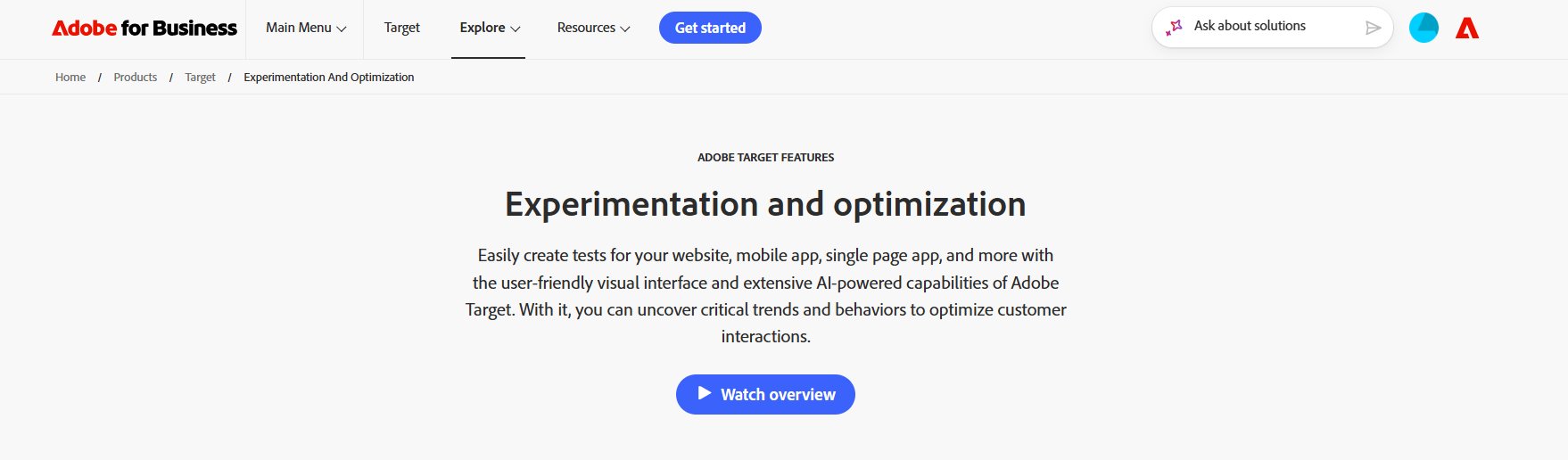
Adobe Target is an enterprise experimentation and personalization platform that supports visual website testing alongside other testing methods. It helps companies scale A/B and multivariate testing across digital experiences while connecting experiments with customer data, analytics, and content from the wider Adobe ecosystem.
Statistical engine: Frequentist and Bayesian
Best fit: Enterprises already using Adobe Experience Cloud
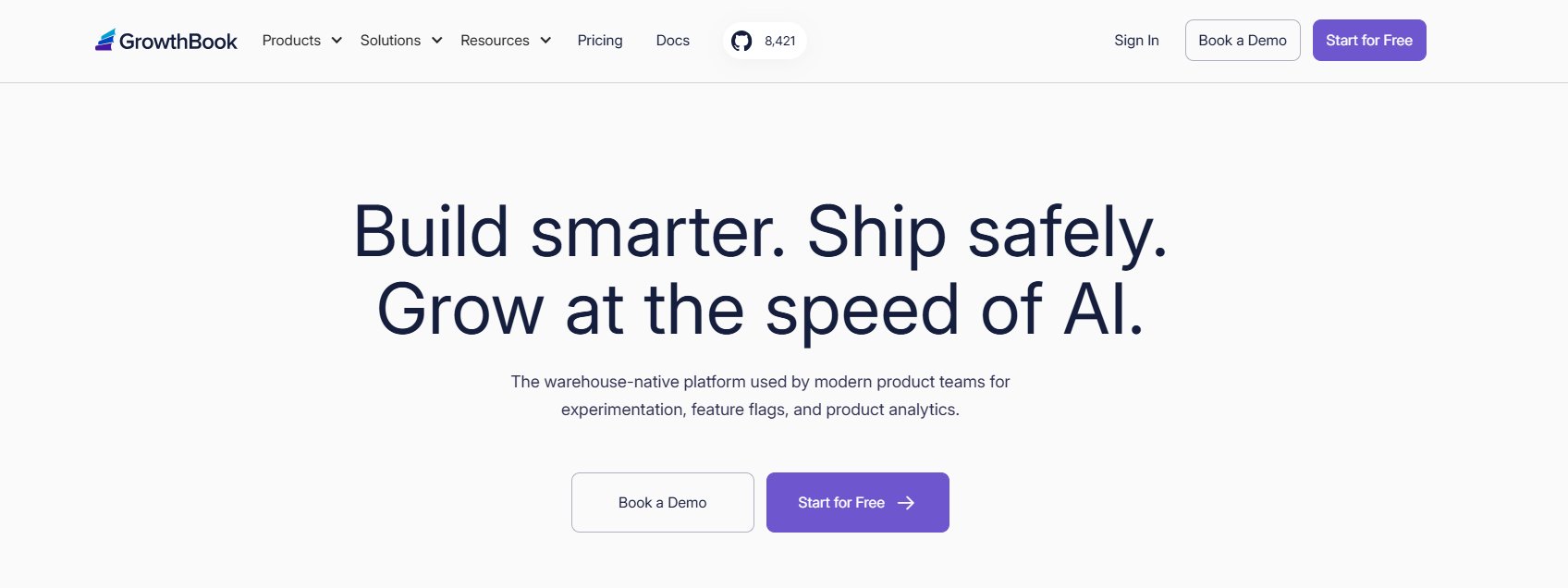
GrowthBook is an open-source, warehouse-native experimentation platform. It analyzes experiments using data from the company’s existing warehouse, helping data and engineering teams retain a consistent source of truth as experiment volume increases.
Statistical engine: Bayesian and frequentist, with CUPED and sequential testing
Best fit: Engineering and data teams with an established warehouse that want flexible, warehouse-native experimentation.
Price: Free cloud plan for up to three users and a free self-hosted plan with unlimited users; paid plans are also available
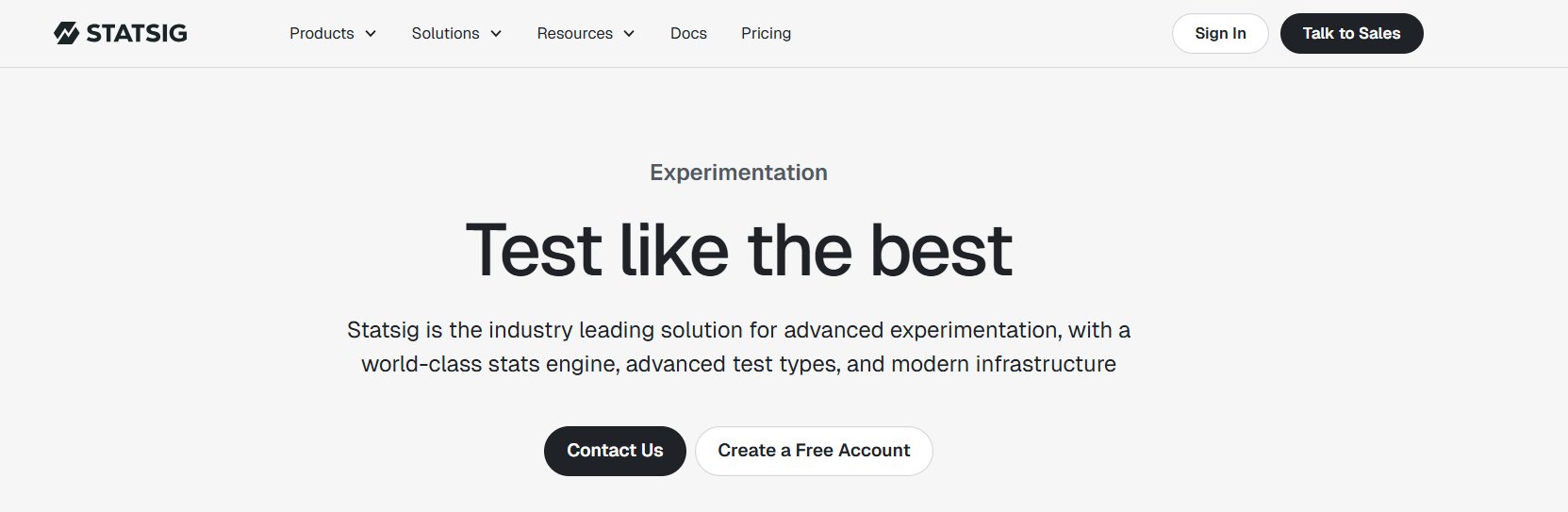
Statsig is a product experimentation platform that combines experiments with feature management, product analytics, and session replay. Its cloud and warehouse-native models help product teams increase experiment volume without separating assignment, measurement, feature delivery, and behavioral analysis across multiple tools.
Statistical engine: Frequentist, Bayesian, and sequential methods, with CUPED and multiple-comparison controls
Best fit: Product-led teams seeking statistical rigor without managing a self-hosted experimentation platform. Amplitude announced in May 2026 that it would take on Statsig’s brand and customers and maintain and develop the existing Statsig platform.
Price: Developer plan includes two million metered events per month at no charge; paid plans scale with usage.
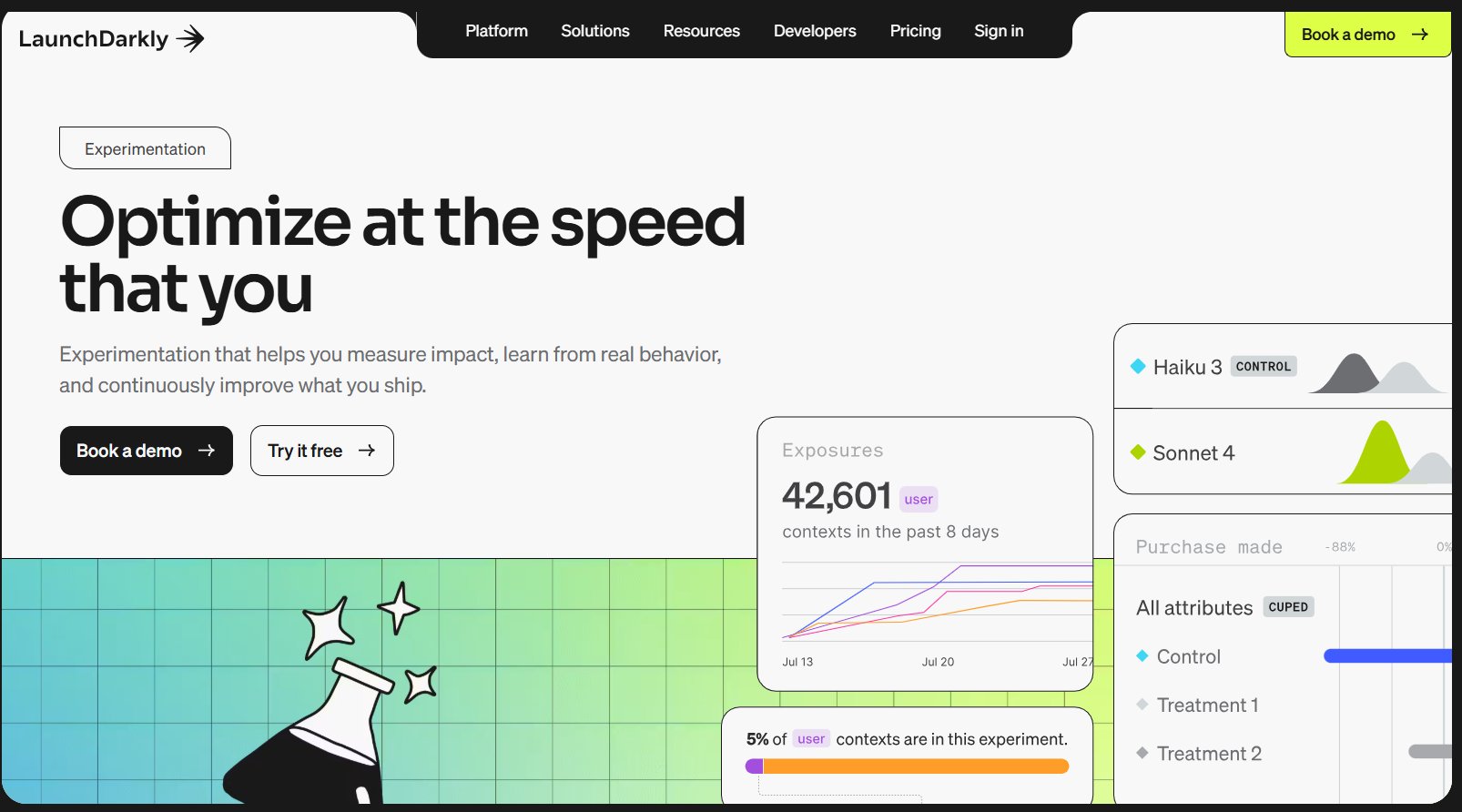
LaunchDarkly is a feature management and experimentation platform built around runtime control, progressive delivery, monitoring, and release governance. It helps engineering teams experiment with product features while managing targeting, rollout, rollback, and measurement across the feature lifecycle.
Statistical engine: Frequentist and Bayesian, including fixed-horizon and sequential frequentist analysis
Best fit: Engineering-led organizations that need scalable feature governance and experimentation across complex applications
Price: Free Developer plan with unlimited seats; paid plans scale with usage
PostHog is a behavioral and product analytics platform with experimentation, session replay, feature flags, and surveys. It helps product teams connect behavioral context with experiment results without manually reconciling data across separate testing and analytics tools.
Statistical engine: Bayesian and frequentist
Best fit: Developer-led product teams wanting experimentation and behavioral analytics within the same platform
Price: Usage-based, with the first one million product analytics events free each month
Wingify is an Agentic Experience Optimization Platform that connects analytics, experimentation, feature management, and personalization in one system. It helps marketing, product, engineering, and data teams optimize digital experiences at scale. Its capabilities include:
Analytics: Understand user behavior with Behavior Analytics, Journey Analytics, and User Feedback to uncover friction and form hypotheses.
Experimentation: Run A/B, multivariate, and split URL testing, supported by a visual editor, targeting, segmentation, and variation-level reporting to identify what drives better outcomes.
Feature Management: Manage features across the lifecycle with feature flags, SDK-based experimentation, progressive delivery, controlled rollouts, monitoring, and rollback.
Personalization: Create more relevant experiences with customer and behavioral data. Data Studio, Predictive Data, and Emotions help teams build audiences and deliver more relevant experiences.
Wingz: Wingz, Wingify’s embedded agentic AI layer, connects experiments, audiences, metrics, and behavioral context to help teams identify opportunities, generate hypotheses, build variations, analyze results, and decide what to do next.
Pro Tip!
Bring experimentation into your existing development workflow with Wingify’s MCP Server. Connect Wingify to your AI-powered development environment and use natural language prompts to create feature flags, configure rollout rules, generate SDK code, retrieve metrics, and trigger instant rollbacks. This helps engineering teams manage experimentation and feature delivery without constantly switching between tools or manually configuring every step.
Statistical engine: Bayesian-powered SmartStats calculates the probability that one variation will outperform another, communicates uncertainty, and flags actions that could compromise test reliability.
Best fit: Companies seeking a connected Agentic Experience Optimization Platform.
Price: Custom pricing based on traffic volume, selected products, plans, and implementation requirements.
Request a demo to experience the Wingify platform and know how it can help scale A/B testing at your organization.
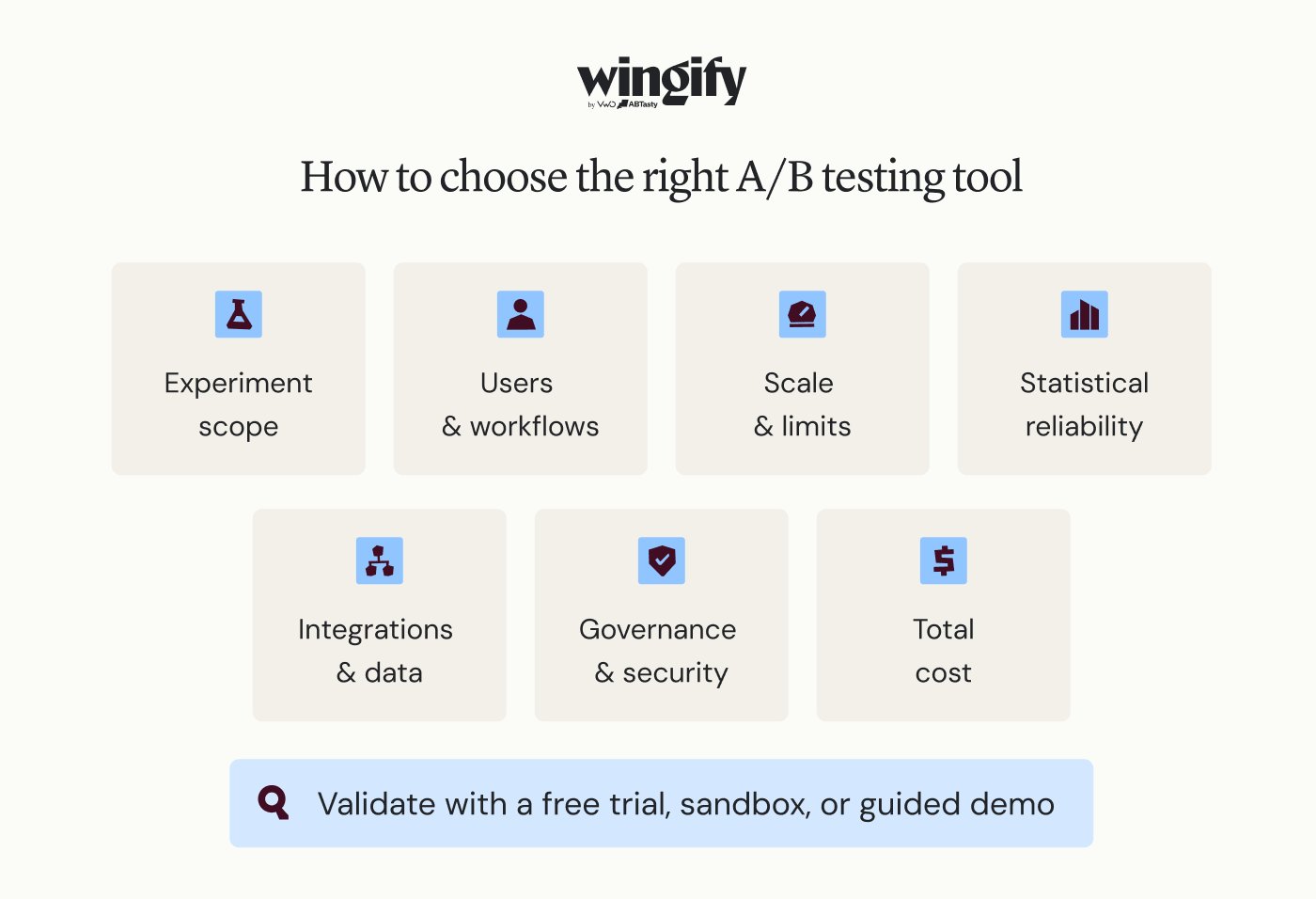
How to choose the right A/B testing tool
Once you have shortlisted the platforms, evaluate them against the conditions in which your experimentation program will operate:
Define where you need to experiment: Determine whether testing will remain limited to websites or expand to mobile apps, product features, algorithms, pricing logic, and personalized experiences. This establishes whether you need web experimentation, feature management, or a broader platform.
Identify who will use the tool: Marketing and growth teams may prioritize a visual editor and behavioral insights. Product, engineering, and data teams may require SDKs, feature flags, warehouse connections, and programmatic controls.
Estimate scale: Assess traffic volume, monthly tracked users or events, concurrent experiments, participating teams, and expected test growth. Check which usage limits or plan thresholds would trigger an upgrade.
Evaluate statistical reliability: Review how the platform evaluates experiment results, including sample-size planning, sequential testing, guardrail metrics, sample ratio mismatch detection, and controls for multiple comparisons. Document the methodology so decision-making teams can understand it.
Check integration and data requirements: Confirm that the platform works with your analytics, data warehouse, customer data, content management, and identity systems. Also establish where experiment data will be stored and how easily it can be exported for deeper analysis.
Assess governance and security: As more teams begin testing, role-based access, approval workflows, workspaces, audit trails, and experiment coordination become essential. These considerations matter most for enterprise teams because they often operate across multiple departments, regions, and technology environments while handling larger volumes of customer data. They should also review security, privacy, compliance, and data residency requirements.
Calculate the total cost: Look beyond the base subscription. Include charges linked to traffic, events, seats, add-on capabilities, implementation, support, and the engineering effort required to operate integrations or self-hosted infrastructure.
Before committing, use any free trial, sandbox, or guided demo the platform offers to run a realistic test based on your planned use case. Assess setup time, variation delivery, data accuracy, reporting clarity, integration quality, and usability for each participating team.
How to build a scalable A/B testing stack
Whether delivered through one platform or several specialized tools, a scalable A/B testing stack needs five functional layers:
Experimentation layer: The web experimentation or feature management platform responsible for user assignment, variation delivery, statistical analysis, and controlled rollout.
Behavioral analytics and feedback layer: Heatmaps, session recordings, journey analytics, and user feedback help teams identify friction and form hypotheses before an experiment. Afterward, they even provide context for why users responded differently and help determine what to test next.
Real example: Flos USA worked with Wingify to combine quantitative analytics with heatmaps, scrollmaps, and session recordings to identify opportunities across its homepage, product listings, product pages, cart, and checkout. The team translated these insights into hypotheses and ran 30 campaigns across the customer journey.
Over 18 months, this structured approach increased the checkout conversion rate by 125% and delivered an 18x ROI, showing how connected behavioral insights and systematic experimentation can support sustained optimization rather than isolated tests. Read the full success story here.
Data layer: A customer data platform or warehouse that connects behavioral, identity, CRM, product, revenue, and cohort data, allowing teams to evaluate experiments beyond immediate conversion metrics. WingifyData Platform, for example, brings these signals together under a shared customer identity and makes the same context available across its suites.
Reporting layer: Dashboards that surface statistical results, segment-level breakdowns, campaign status, and program performance so stakeholders can monitor progress without requesting separate reports. Wingify manages this through multiple dashboards designed for campaign analysis, insights, and program-level reporting.
Intelligence layer: The layer that synthesizes information from the other four, identifies significant patterns, connects them with business outcomes, and turns the learning into possible next actions or test ideas. Wingzgoes beyond dashboards to find patterns worth paying attention to, connect them to revenue, and turn them into test-ready ideas.
Every additional vendor across these layers creates another integration to maintain and another potential data discrepancy to resolve. This makes the choice between a connected platform and a specialized stack an architectural decision, not simply a feature comparison.
Testing is more of a mindset, than a concoction of tools. It is important to choose tools that allow low-code testing, plug easily into CRM and analytics systems, and offer fast insights. The right stack is not always the fanciest; it’s the one that lets you move fast and learn faster.
Mayowa Aderogbin, Head, Business Marketing, Pierrine Consulting (Source: CRO Perspectives)
Common challenges when scaling A/B testing tools
Scaling introduces coordination, infrastructure, and governance challenges that are less visible when only a few teams or experiments are involved:
Fragmented tools and data: Using separate platforms for testing, analytics, feature delivery, personalization, and customer data can create integration overhead and conflicting results. Establish shared identities, metric definitions, and data flows across the stack.
Overlapping experiments: As concurrent test volume grows, experiments may target the same users or influence connected parts of the customer journey. Use a central experiment calendar, audience controls, and mutually exclusive groups to manage interactions.
Governance bottlenecks: More teams require greater oversight, but applying the same approval process to every test can slow execution. Set permissions and review requirements according to experiment risk.
Data privacy and compliance risks: As experimentation scales, data flows across testing, analytics, customer data, and warehouse systems.
Different or unclear rules for access, retention, storage, and data sharing can make privacy governance harder. Regularly review data flows, access controls, and consent requirements to prevent compliance gaps.
Implementation and maintenance load: Additional tags, SDKs, events, and integrations increase the work required to maintain performance and data accuracy. Standardize implementation patterns and include technical validation in experiment QA.
Difficulty prioritizing at scale: A growing backlog can direct traffic and resources toward low-impact ideas. Use a consistent prioritization framework based on evidence, expected impact, effort, and strategic relevance.
Rising platform costs: Charges based on traffic, tracked users, events, seats, or add-ons can increase quickly as adoption grows. Forecast costs against expected test volume and include implementation, support, and integration expenses.
Best practices for using A/B testing tools at scale
A scalable platform still requires consistent operating practices. Use the following measures to maintain speed without weakening test quality:
Standardize experiment setup: Use a common brief covering the hypothesis, target audience, primary and guardrail metrics, required sample size, expected duration, and rollout plan.
Assign access by responsibility: Configure roles, permissions, workspaces, and approval workflows so teams can operate independently within clear controls.
Coordinate audiences and traffic: Review active experiments before launch and use targeting rules or mutually exclusive groups where overlapping exposure could affect results.
Build QA into the workflow: Check variation delivery, event tracking, traffic allocation, performance impact, and responsive behavior before and during every test.
Maintain a central experiment repository: Record hypotheses, configurations, results, segment findings, and decisions in one searchable location so teams can reuse previous learning.
Roll out winners in stages: Use feature flags or controlled releases to expose a successful variation gradually while monitoring guardrail and downstream metrics.
Track program performance: Monitor test velocity, implementation rate, time from idea to launch, and the business impact of deployed winners, not only individual test win rates.
Monitor data quality and privacy: As the testing stack grows and more systems exchange experimentation and customer data, regularly review data accuracy, data flows, access controls, and consent requirements to prevent privacy or compliance gaps as the program scales.
Build a more connected, scalable testing program
Running more experiments doesn’t automatically translate into better results. As testing spreads across teams, channels, and customer journeys, disconnected tools and fragmented insights can make it harder to identify opportunities, act on findings, and measure their impact. Scaling requires a setup that connects these activities rather than adding more layers to manage.
Wingify brings behavioral analytics, experimentation, feature management, personalization, and AI-powered intelligence together within one platform. Request a demo to see how Wingify can help your teams coordinate experiments, uncover optimization opportunities, and deliver better digital experiences at scale.
FAQs
What are the best tools for scaling A/B testing?
The best tools support multiple testing environments, reliable statistical analysis, audience management, behavioral insights, integrations, and cross-team governance. Wingify is a strong option. It brings experimentation, feature management, behavioral analytics, personalization, unified customer data, and the Wingz intelligence layer into one system, reducing the need to connect and manage multiple specialized tools.
How do A/B testing tools help scale experimentation?
A/B testing tools automate audience assignment, variation delivery, statistical analysis, and reporting, enabling teams to run more growth experiments without multiplying manual work. At scale, they also help teams coordinate concurrent tests, standardize workflows, manage access, monitor test quality, and retain experiment learnings.
How do I choose the right A/B testing tool for my business?
Choose based on where you plan to test, who will operate the platform, your traffic and experiment volume, statistical requirements, integrations, governance needs, and total cost. Use a free trial or guided demo to evaluate the platform with a realistic use case before committing.
What are the tools for AB testing?
A/B testing tools include web experimentation platforms, feature management platforms, product experimentation tools, warehouse-native and open-source solutions, and behavioral analytics and feedback tools. Businesses may use specialized tools from one or more categories or choose a connected experience optimization platform that combines these capabilities.
What are the top 5 automated testing tools?
Five notable tools that automate core A/B testing workflows are Wingify, Adobe Target, GrowthBook, Statsig, and PostHog. They support traffic allocation, variation delivery, metric tracking, statistical analysis, and automated reporting, though their specializations differ.
What are QA tools?
Quality assurance tools help teams find defects and confirm that software works as intended. They support activities such as functional testing, browser testing, API testing, performance testing, bug tracking, and test management.
Which tools are used for testing?
A/B testing programs may use web experimentation platforms, feature management tools, behavioral analytics platforms, and warehouse-native solutions. Examples include Wingify for connected agentic experience optimization, Adobe Target for enterprise web experimentation, LaunchDarkly for feature management, PostHog for behavioral analytics, and GrowthBook for warehouse-native experimentation.
Hi, I’m Pratyusha Guha, manager - content marketing at VWO. For the past 6 years, I’ve written B2B content for various brands, but my journey into the world of experimentation began with writing about eCommerce optimization. Since then, I’ve dived deep into A/B testing and conversion rate optimization, translating complex concepts into content that’s clear, actionable, and human. At VWO, I now write extensively about building a culture of experimentation, using data to drive UX decisions, and optimizing digital experiences across industries like SaaS, travel, and e-learning.
You might also love to read these on Your Guide to Feature Flags
15+ Min Read
Rolling Deployment Explained: How Batch-by-Batch Releases Work