Large language models (LLMs) have changed how people reach a digital touchpoint.
Earlier, visitors used to land on a webpage through a broad search from a search engine, read their way toward understanding the category, and eventually reach a product page.
Currently, a lot of that education happens on an LLM. Someone asks an AI model to compare the options, gets a summary of four vendors including you, forms an opinion, and only then clicks through. The visit that shows up in your analytics might be the end of the visitor journey rather than the beginning of their research. And we cannot be sure exactly what people are searching for, or the keywords they are using.
So the person landing on your pricing page is not a cold visitor who wandered in. They have already narrowed the field; they arrive with a specific objection they want resolved, and they will leave in under a minute if the page is written for someone three steps behind them.
When visitors arrive further along in their journey and with less patience, the cost of showing someone an irrelevant experience goes up sharply. And this is just one change in behavior. Your customer behavior is changing as you are reading this.
Catching this early is the difference between growth and contraction on the online channel.
“Traffic is a big challenge now. There’s a scarcity of it. AI is taking traffic away globally, and plenty of brands report steep declines. Traffic is no longer a luxury, which means conversion becomes far more important. If your traffic is down by approx. 30%, you need to convert at least 30% better just to get the same business outcome.”
– Sparsh Gupta.
Co-founder and CEO at Wingify
Analytics tells you what happened, but there is a catch
Most teams do have the evidence of a shift in visitor behavior, and it’s sitting in session recordings, heatmaps, funnel reports, and whatever product analytics tool the company standardized.
The problem is the distance between having the evidence and acting on it. As somebody from the team has to,


Each step is stacked such that the insight that arrives on day one becomes a live change five weeks later. These steps run at human speed, and that’s the part automation has to take over to keep you relevant with changing customer behavior and expectations.
Wingz, the intelligence layer that keeps your experience relevant
Wingz is Wingify’s agentic AI layer across the optimization loop. It connects capabilities across analytics, experimentation, personalization, feature management, commerce, and engagement to automate the work of identifying visitor behavior, deciding what to do, taking action, and interpreting the results.
The loop gets more powerful when the signals, decisions, actions, and learnings don’t live in separate systems. A behavior signal shouldn’t end in analytics. A test result shouldn’t disappear into a report. A personalization shouldn’t become a one-off campaign. When the same intelligence travels across the platform, every interaction adds context to the next one.
“Experimentation teams don’t lack ideas or data. They lack time to connect the two. Wingz closes that gap. You can ask it why a funnel is leaking, get an answer grounded in your own analytics, session recordings, and heatmaps, and turn that insight into a live variation just by describing it. And because every insight cites its evidence and every account’s data stays isolated, teams can trust what it tells them.”
–
Divyanshu Kalra,
Director of Data Sciences at Wingify
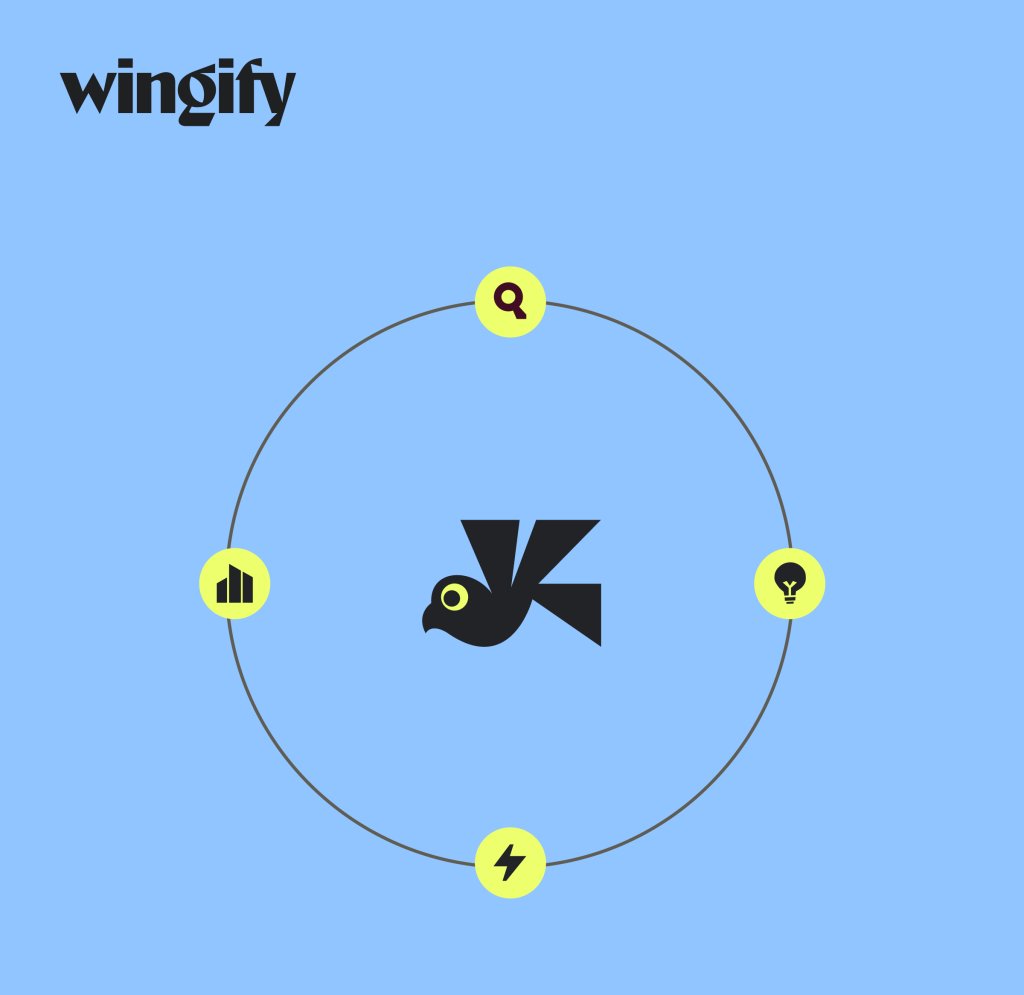
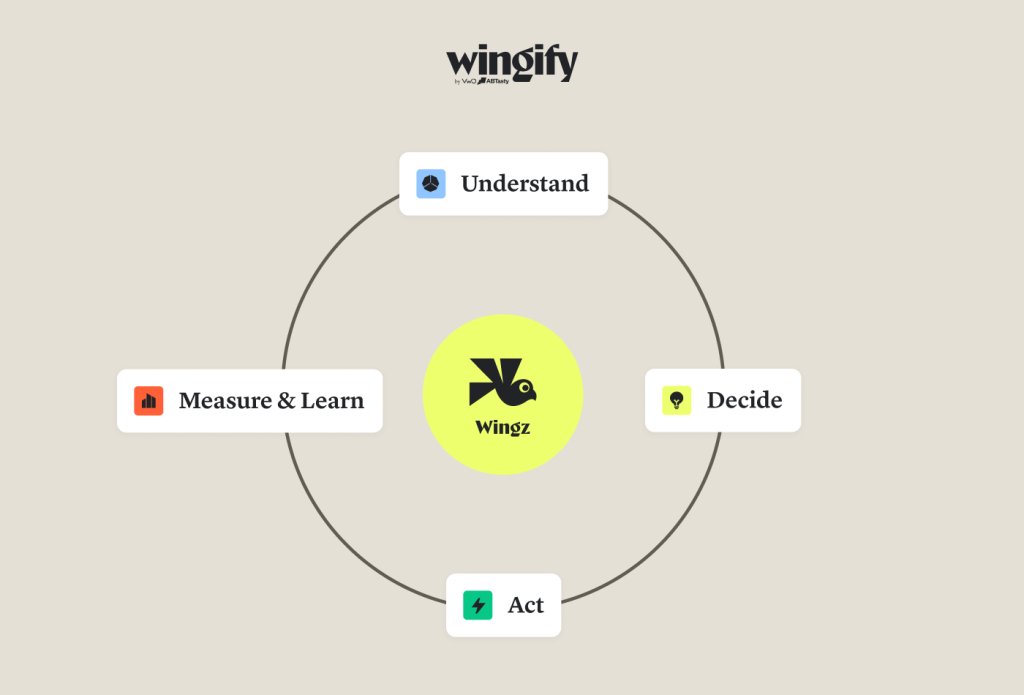
Relevance changes as visitor behavior changes. That’s why it can’t be something you configure once and leave running. Wingz automates and builds a relevance loop that keeps running through four stages:
Understand: Wingz reads your behavioral data the way an analyst would, surfacing the friction that’s costing you revenue.
Decide: It picks what’s worth changing, which is the step most tools hand back to you.
Act: You describe what you want to learn in plain language, and Wingz builds the variation, sets the targeting, and puts it live.
Measure and learn: It reads the result, because a change that isn’t tested is still a guess, and then it does the thing that makes this a loop: the result changes what it proposes next.
The last part is what separates this from asking a model for advice. A language model’s job ends when it hands you a suggestion. The loop’s job ends at a measured outcome, and that outcome becomes the input to the next decision, which means the system gets more useful the longer your site runs on it.
A static suggestion is only as good as the moment it was given. A loop compounds. Every test, every outcome, every “this worked” or “this didn’t” sharpens the next decision.
The longer your site or app runs on it, the more the system knows about your specific users, your specific funnel, and your specific edge cases. It’s not a one-time consult; it’s a partner that gets sharper the more you work with it.
For customers, that’s the real difference between advice and growth without the guesswork: one gives you a starting point, the other gives you a compounding advantage.
How Wingz touches every customer touchpoint
Relevance isn’t confined to a single page. It follows the visitor across the journey, which is why the loop has to run wherever they interact with your experience:
- The landing page after an ad or an AI citation. Wingz reads how each traffic source behaves once it arrives and tests messaging built for visitors. It carries what wins into how it treats that source next time.
- The homepage, which is no longer the front door for most people. Wingz shows you who still starts there, what they’re actually looking for, and which path they follow before converting. Also, it checks whether that path still holds a quarter later.
- On category and product pages, Wingz reads where attention stops, tests whether the block is imagery, specifications, shipping terms, or review placement, and tells you which one it was.
- If the pricing page is getting the most pre-researched visitors with the least patience, Wingz can test how much explaining a visitor actually needs before they’re ready to act. What it learns on the page shapes what it proposes for the next iteration.
- For customer detail forms and the checkout page, Wingz surfaces the rage clicks and dead clicks nobody reported, then tests the specific field causing them and keeps watching once the fix is live.
- For visitor segments, Wingz lets you ask what differs between the segments and run a different message to each, and updates that split as the segments themselves shift.
“The feature I’ve found most useful is Wingz and its ability to surface patterns and accelerate interpretation of test results, because it helps us move more quickly from raw experiment data to actionable insights. Rather than replacing our analysis, it acts as a strong assistive layer by helping summarise performance trends, highlight meaningful differences between variants, and speed up the synthesis of learnings that we can feed back into our roadmap. For us, that has been most valuable after a test has run, when the priority shifts from execution to understanding why a result occurred and what to do next.”
– Ben Hoefel,
Product Owner at NRMA Parks and Resorts
Acting fast is the only lever left
A slow experimentation loop makes your site lack coherence to how visitors actually behave right now. The layout or the copy that converted last quarter may do nothing this one, and a program running weeks behind is always optimizing for the site it had rather than the site it has. Running the loop at the speed things actually change is what keeps relevance from slipping. That’s what Wingz automates.
Ready to close the loop? See how Wingz turns visitor signals into action, and action into the next learning. Book a demo, and we’ll walk through your data.
Frequently asked questions
It depends on which part of the loop you’re in. At the build stage, describing a change in plain language produces a ready-to-review variation in seconds – work that previously took hours of manual effort.
At the analysis stage, Wingz compresses a full cycle of reading heatmaps, session recordings, funnels, and campaign results into a single workflow, so teams can act on what the data shows instead of scheduling the analysis for later.
No. Wingz handles the analysis and the build; your team decides what gets tested and when, and nothing goes live without your approval.
How much Wingz runs is a dial, not an all-or-nothing switch: start with propose-and-approve, move to acting inside guardrails, and earn your way to autopilot over time. The safeguards stay on throughout – an approval gate, guardrail metrics, traffic caps, a kill switch, and a permanent holdout.
Wingz is built to be transparent. Every insight cites its evidence, and you can follow any recommendation back to the session recordings, heatmaps, or campaign data behind it.
No. Every account’s data stays isolated, and what Wingz learns from your traffic shapes what it suggests for your site and nowhere else. Wingz runs under Wingify’s Responsible AI Policy and the same certified security program as the rest of the platform, including ISO 27001, ISO 27701, SOC 2 Type II, GDPR, CCPA, and HIPAA.
Rolling out a winner is your call since Wingz doesn’t change live campaigns on its own. Because behavior shifts, optimization is continuous. With workflows, you can schedule a recurring check that re-examines a page or campaign and flags when a previously winning variation has stopped performing.
Categories:

I’m a content marketer at VWO, reading and writing on topics like behavior analytics, conversion rate optimization, and experimentation. Prior to VWO, I built and managed my own website where I discussed business growth and career. When I’m not at my desk, you’ll find me exploring nature trails, cycling through the countryside, or seeking out new physical challenges—those are my ideas of a good time! Want to start a conversation with me? Just mention BIRDS, and you’ll have my undivided attention.