When you hear “A/B testing (link to 301 redirect wingify article),” does your mind immediately jump to a neat revenue uplift? It’s a common reflex. After all, ROI is the language of leadership, and there’s no easier way to justify a budget than by showing exactly what you’ve gained. But here’s the thing: while the dollar sign is a powerful motivator, focusing only on immediate revenue can actually limit your growth. Real experimentation ROI is about more than just a quick win; it’s about making better decisions, minimizing risk, and building a culture where curiosity leads to confidence.
Why do we talk about ROI?
In today’s world, the era of “growth at all costs” is behind us. Leadership is more careful with budgets, and every investment needs to prove its worth. Communicating ROI helps you:
- Get buy-in: Speak the language your bosses understand.
- Show concrete data: Move past opinions and lead with evidence.
- Prioritize with purpose: Tie potential revenue to your testing ideas so you know exactly where to start.
The hurdle: Why measuring ROI is a tricky flight
If ROI was a simple math equation, everyone would do it. But assessing the true impact of an experiment is a complex journey. You’ll often run into three main challenges:
- Forecasting is a guess (at best): From paid traffic strategies to societal shifts, dozens of external factors can blur your results. You can forecast an ROI trend, but predicting an exact figure for the next 12 months is nearly impossible.
- The “average” trap: If you run a high-performing test on a specific audience, that uplift can often get swallowed up when you look at your global conversion rate. The “average” can hide the real progress you’re making in the corners others miss.
- The “revenue-first” pitfall: If you only care about immediate gain, you might cannibalize the customer experience. No free returns or cheap packaging might save money today, but it kills loyalty tomorrow.
How to estimate your potential ROI
To move past the guesswork, you need a structured way to estimate your brand’s impact. Before you launch a test, gather your data:
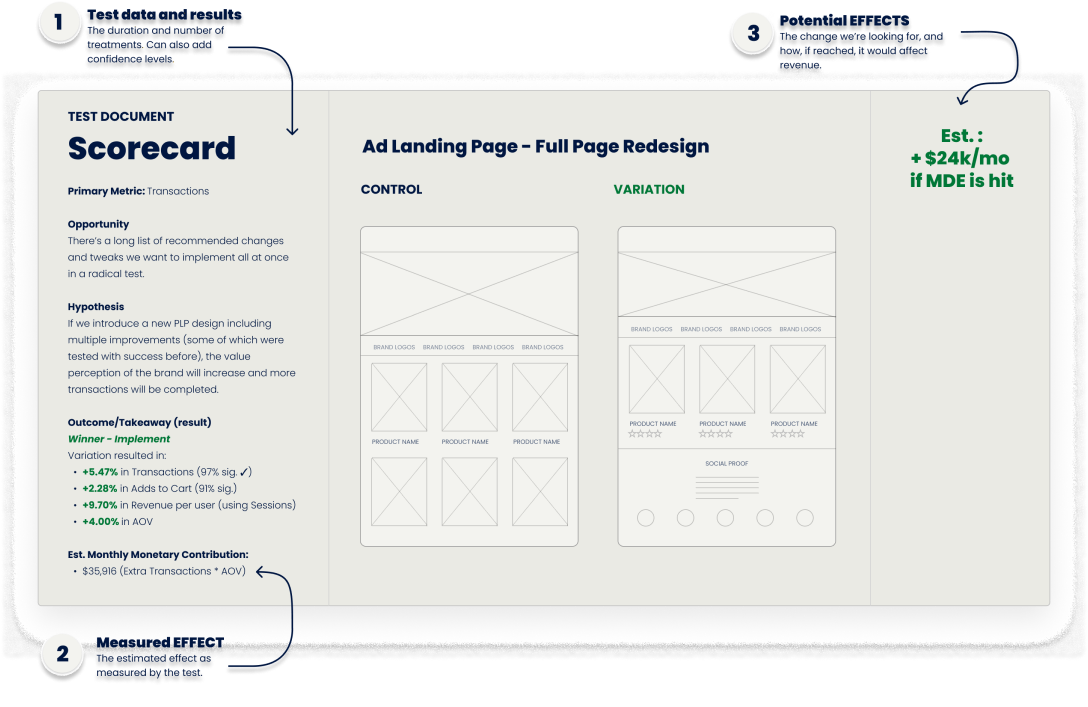
Minimum detectable effect (MDE): What is the smallest change that would make this test meaningful? Using an A/B test calculator can then help you estimate your sample size, duration, and the potential Revenue Impact (AOV x Additional Conversions). This turns an abstract idea into a clear, measurable goal.


Show and tell: Using scorecards and QBRs
The best way to combat skepticism is with transparency.
It’s a great idea to use individual Testing scorecards to share your hypothesis, the outcome (even the losses!), and the estimated monetary contribution. On a larger scale, Quarterly business reviews (QBRs) let you look closer at the last three months of performance and plan the next three months of strategy. It’s your chance to turn data into stories that resonate with your leadership team and prove that experimentation is a strategic investment, not just a series of isolated tests.
Look closer, see further
At the end of the day, experimentation isn’t just about the “win” but about the learnings. Every test, whether it results in an uplift or a saved loss, moves your business in a better direction. Stay curious about your customers, stay creative with your testing, and let the cumulative power of better decisions pave your path to long-term growth. Because when you take the guesswork out of things, the sky isn’t the limit: it’s just the beginning.
FAQs: Experimentation ROI
While revenue is a key goal, experimentation is also about minimizing risk, learning from user behavior, and making data-driven decisions that improve the customer experience. Focusing solely on immediate financial gain can lead to short-term wins that actually hurt your long-term brand loyalty.
The most accurate way is to combine individual test scorecards with a long-term ROI benchmark model that tracks your traffic, conversion rate, and average order value. By regularly updating your stakeholders through QBRs and automated reports, you can show the cumulative financial impact of your optimization efforts.
A “loss” is still a win for your business because it prevents you from implementing a change that would have hurt your conversion rate. This is called “discovered revenue” or “saved loss,” and it’s a vital part of showing the overall value of your experimentation program to your leadership team.
Categories:

Annika has over 12 years of experience in experimentation. Since starting at Speero in 2017, she has been working with UK and EU companies like Decathlon, RS Component, Charles Tyrwhitt shirts and many others helping them scale their Center of Excellence and start/run/scale experimentation programs.