Marketing managers are constantly being asked to do more with less, which means tighter budgets, higher conversion targets, and increasing pressure to justify every campaign decision.
A/B testing is one of the few methods that directly addresses all three.
It can help marketers replace guesswork with evidence, allocate budget to what actually works, and optimize vital business metrics such as conversions and revenue.
But finding the right A/B testing platform is a challenge in itself.
This blog focuses specifically on the tools marketing managers need that are fast to set up, easy to use without developer support, and rigorous enough to trust the results.

Why A/B testing is critical for marketing managers
Below are some reasons why A/B testing has become a core capability for modern marketing teams.
1. Validate ideas to see how they impact user behavior
A/B testing enables marketing managers to test their ideas with real users under controlled conditions.
For example, if visitors are abandoning a lead-generation form at a high rate, the hypothesis might be that the form is too long.
You test a shorter version, measure completion rates, and let the data decide.
By splitting traffic between variants and measuring the impact on user behavior, marketers can test different versions and determine which one actually drives better outcomes.
2. Improve conversion and customer engagement across marketing funnels
Small UX or messaging improvements can produce meaningful gains at scale, especially in website funnels where the user journey spans multiple touchpoints.
In-depth funnel analysis paired with optimization at each stage of the user journey often compounds into larger overall conversion gains instead of relying on a single page-level improvement.
3. Maximize ROI from paid acquisition
Businesses often invest heavily in paid acquisition to drive pipeline and revenue growth, which makes the post-click experience just as important as the ad itself.
For example, if an A/B test improves conversion rates on a high-traffic paid campaign page, the business can generate more leads from the same ad spend.
This allows marketing teams to extract more value from existing traffic and improve acquisition ROI without increasing budgets.
4. Reduce risk when launching marketing campaigns
Marketing campaigns often involve hours of planning, tons of resources, and usually a significant budget spent on getting them live.
However, even the best-planned campaign carries a risk of underperforming or not achieving its goal, whether it’s more sign-ups, more leads, or higher revenue.
A smart business strategy would be to incorporate A/B testing, as it enables you to gauge how users respond to the campaign, helping you see early whether it’s likely to hit its goals.
5. Build a continuous optimization engine
The most successful teams treat experimentation as an ongoing process, not a one-time project.
Each test generates valuable insights about user behavior, such as what messaging resonates with users, where friction points exist, and which design patterns perform best.
These data-driven insights then inform new hypotheses, creating a continuous cycle of testing, learning, and optimization.
Core features marketing managers should look for when choosing an A/B testing tool
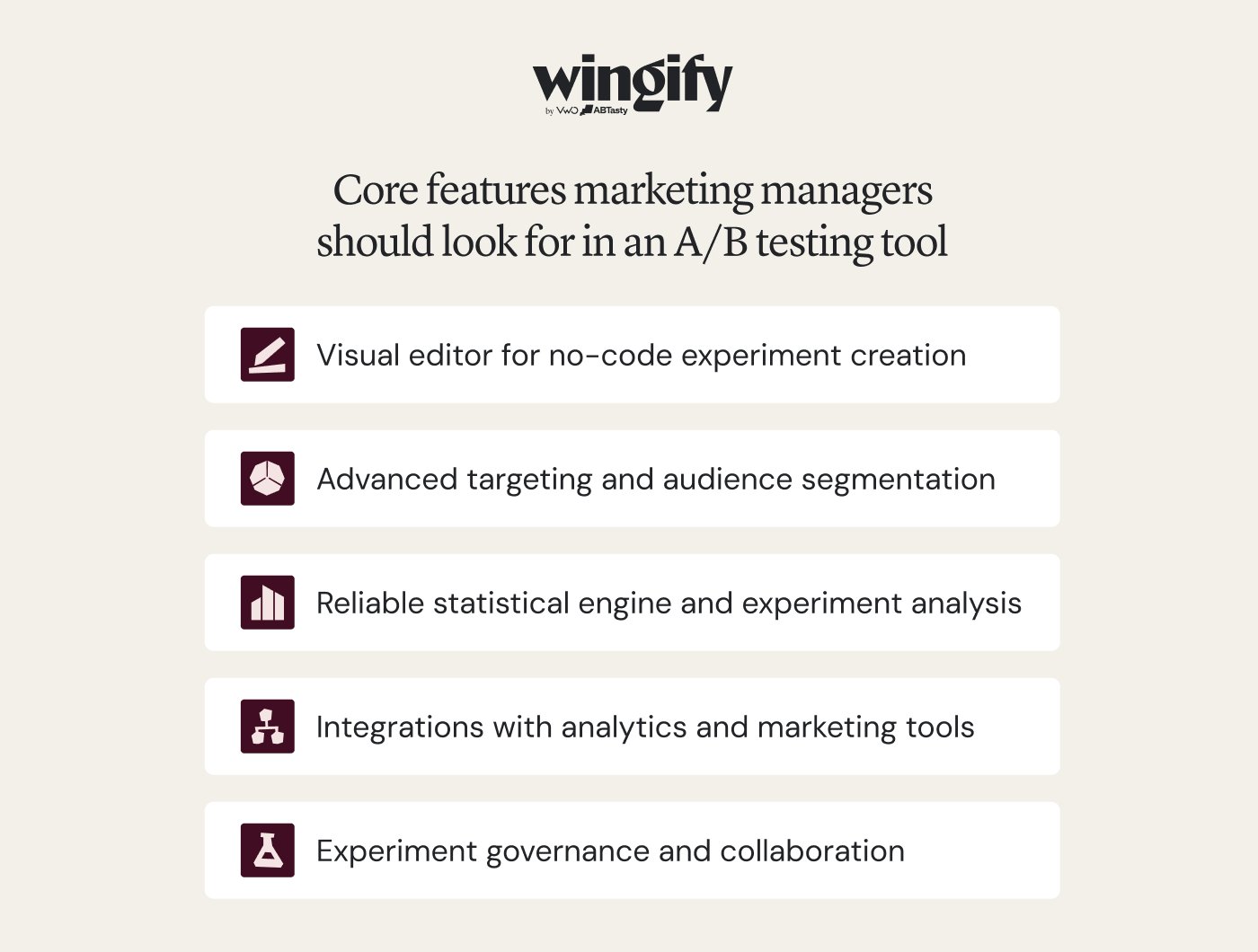
1. Visual editor for no-code experiment creation
Campaigns often run on tight timelines, and waiting on developers to implement every test can slow down experimentation velocity.
A strong A/B testing tool should include an intuitive visual editor that allows you to create experiments directly on a webpage without writing code.
This capability allows teams to launch experiments independently, reducing dependence on engineering teams while increasing the number of tests they can run.
2. Targeting and audience segmentation
An effective testing platform should support granular audience targeting, such as campaign traffic (UTM parameters), new vs. returning visitors, behavioral attributes, and custom segments.
It should also offer segmentation capabilities so teams can create custom segments and import audiences from other tools in their tech stack, such as Google Analytics or other CRM platforms.
It enables marketing managers to run more targeted experiments, ensuring that the right message is tested with the right audience.
3. Reliable statistical engine and experiment analysis
Poor statistical models or incomplete reporting often lead to misleading conclusions and incorrect decisions.
A robust testing platform, whether using Frequentist or Bayesian methodologies, helps ensure that decisions are based on statistically reliable insights rather than temporary fluctuations or premature test stoppage.
It should also provide visibility into key metrics such as sample size, confidence intervals or credible intervals, significance or probability metrics, and segment-level performance to support accurate interpretation of experiment results.
4. Integrations with analytics and marketing tools
Experimentation rarely happens in isolation. Marketing teams rely on a broader stack that may include web analytics tools, CRM systems, marketing automation tools, and customer data platforms.
A good A/B testing solution should integrate with this stack natively, so data flows both ways without manual exports.
These integrations allow teams to combine experimentation data with broader marketing insights, improving reporting, segmentation, attribution, and campaign analysis.
5. Experiment governance and collaboration
As testing programs scale, multiple teams may run tests simultaneously across different campaigns and web pages. Without proper governance, experiments can overlap, conflict, or lead to confusion or misalignment among teams.
Marketing managers should look for features that support scheduling and prioritizing experiments and enable collaboration across marketing, product, and growth teams.
Pro Tip!
Use Wingify Plan to log observations from heatmaps and session recordings, rank hypotheses by impact, confidence, and effort (ICE), and turn your backlog into a structured testing roadmap. When an idea is ready, promote it straight into an experiment, so every test your team runs starts from evidence.
A/B testing software for marketing managers: At a glance
5 best A/B testing software for marketing managers
| Tool | Standout features |
| Wingify Experimentation | – A/B testing, Split URL, Multivariate testing – No-code Visual Editor – Prompt-based campaign generation with Wingz AI – Journey Analytics, User Behavior Analytics, and User Feedback |
| Optimizely | – Agentic Experimentation – Personalization – Optimizely Data Platform (ODP) for audience segmentation |
| Convert | – A/B, Multivariate, and Split testing – Personalization – Visual editor and audience targeting |
| Kameleoon | – Web Experimentation – Prompt-Based Experimentation (PBX) – Personalization |
| Omniconvert | – A/B testing – Surveys and user behavior insights – AI eCommerce engine (Commander, Shopify only) |
1. Wingify Experimentation
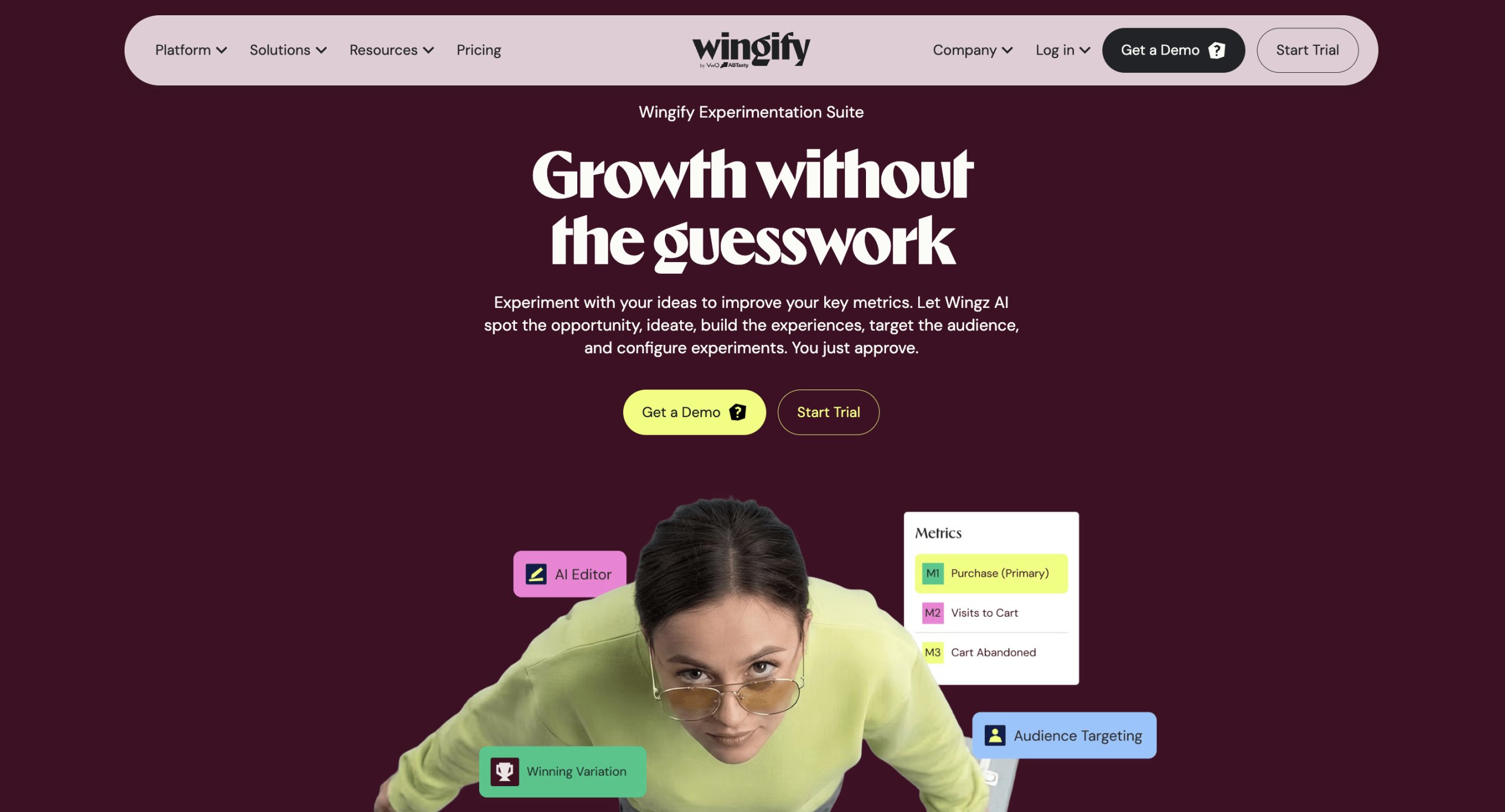
Wingify Experimentation is one of the leading agentic experience optimization platforms for marketing teams seeking depth without relying on developers.
With its no-code Visual Editor, even non-technical users can launch and manage A/B, multivariate, and split URL tests with greater speed and autonomy.
With Wingz, Wingify’s AI layer, you can describe the test you want in a single prompt. Wingz builds the test variations, targeting, and metrics, while you decide what goes live.
Moreover, heatmaps and visitor recordings connect directly to your test results, so you can compare how people interacted with each version and see the why behind each result.
You can also add User Feedback surveys on the same platform to hear it in visitors’ own words.
Key features
- A/B, Split URL, and Multivariate testing
- No-code Visual Editor and prompt-based AI Editor with Wingz
- Integrated heatmaps, session recordings, and User Feedback
- Advanced targeting, guardrail metrics, and Bayesian reporting (SmartStats)
Pricing
Custom, quote-based pricing. A 30-day free trial is available.
2. Optimizely
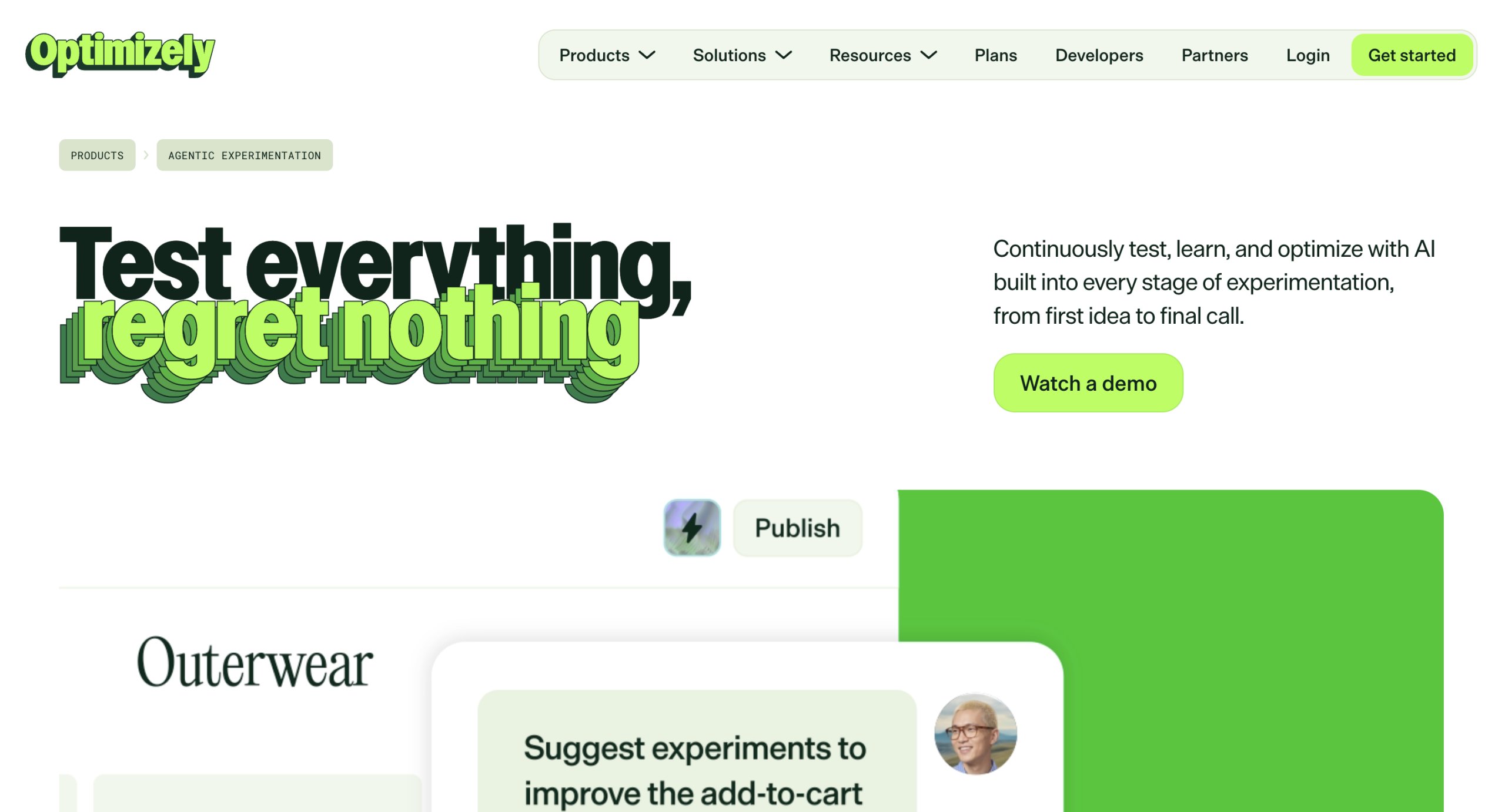
Optimizely’s Agentic Experimentation combines web and feature experimentation in one product, covering A/B, multi-page, and server-side testing, with AI built in from test ideas to results.
The Optimizely Data Platform (ODP) enables advanced audience segmentation using behavioral, CRM, and first-party data.
Teams can also use Optimizely’s Content Marketing Platform and Agentic CMS to manage and scale their content campaigns.
Key features
- Web and server-side testing with a visual editor
- AI agents for test ideas, planning, and analysis
- Personalization and audience segmentation (ODP)
Pricing
Custom pricing. Every plan is individually packaged. No self-serve free trial is listed.
3. Convert
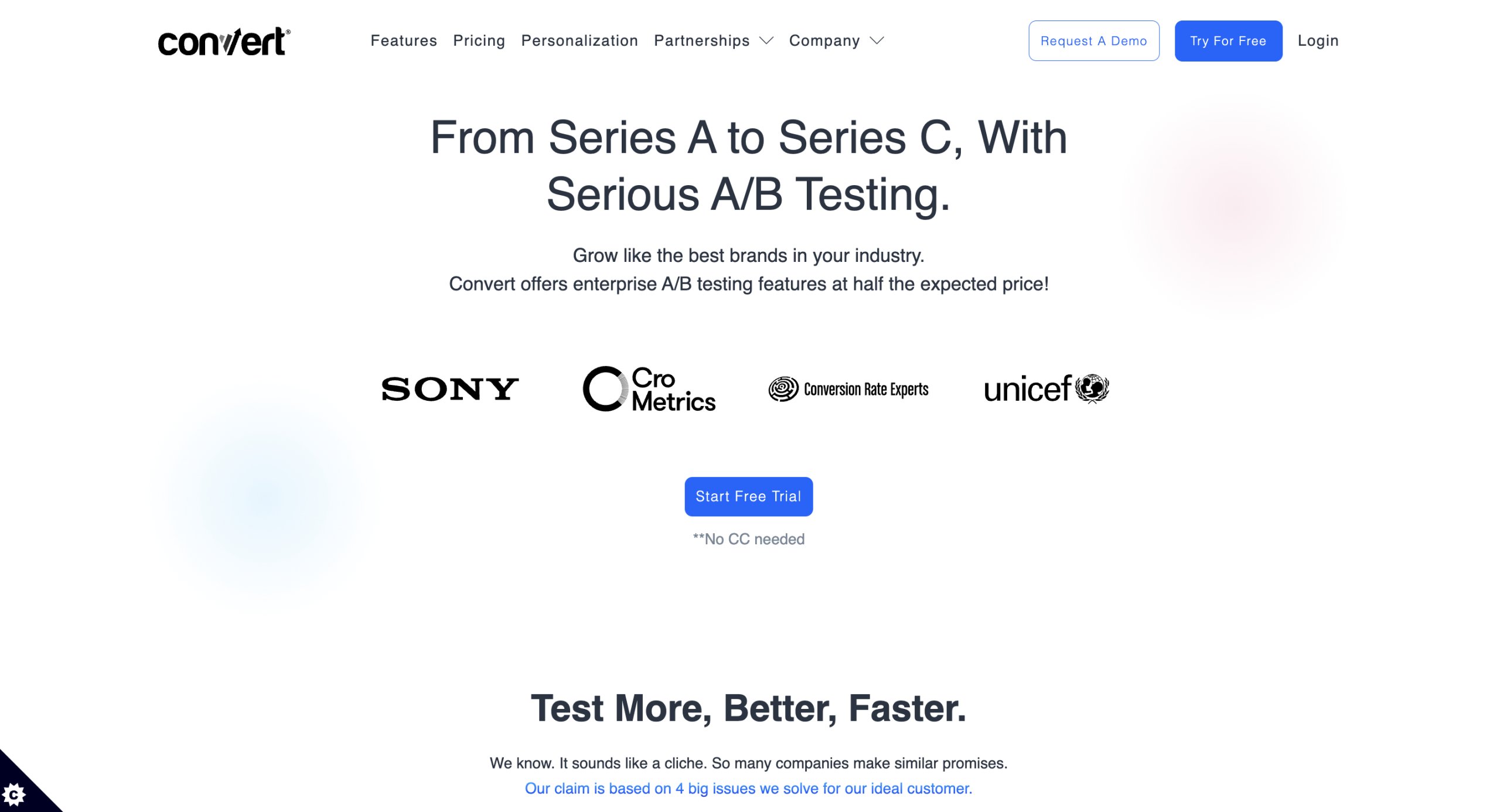
Convert is a robust experimentation platform that supports A/B and split URL testing, with an advanced targeting engine offering 40+ filter options.
Its Pro plan adds multivariate, multi-page, and full-stack testing with feature flags.
Built-in heatmaps and Convert Intelligence, its AI assistant (currently in beta), help teams set up variations, analyze test results, and generate test hypotheses.
Key features
- A/B and Split URL testing (Multivariate on Pro)
- 40+ filter targeting engine and advanced goals
- Heatmaps and Convert Intelligence (beta)
Pricing
Plans start at $299/month billed annually ($399/month billed monthly). A 15-day free trial is available.
4. Kameleoon
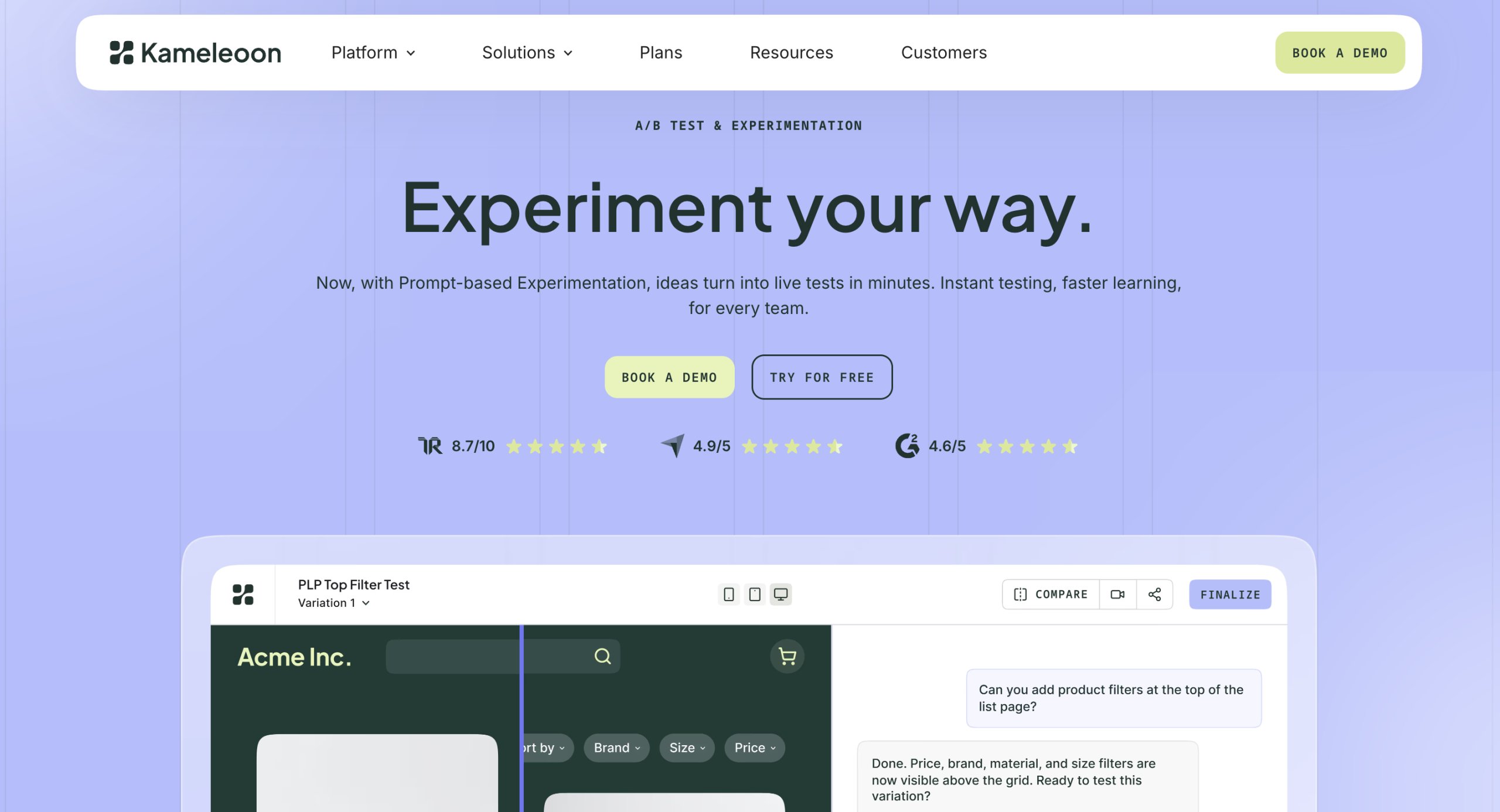
Kameleoon is an experimentation platform built around PBX (Prompt-Based Experimentation), which lets you describe the change you want to test in plain language and have AI build the variation.
Plans for enterprise users add server-side testing, feature management, and advanced personalization.
Its AI Targeting add-on scores visitors by conversion intent, and its product recommendation and search add-on is especially useful for retail and eCommerce marketers.
Key features
- Prompt-Based Experimentation (PBX)
- 40+ segmentation criteria and sequential testing
- Personalization, AI Targeting, and Recommendations (add-ons)
Pricing
Starts at $495/month (PBX Starter). Enterprise pricing is custom, and a 30-day free trial is available.
5. Omniconvert
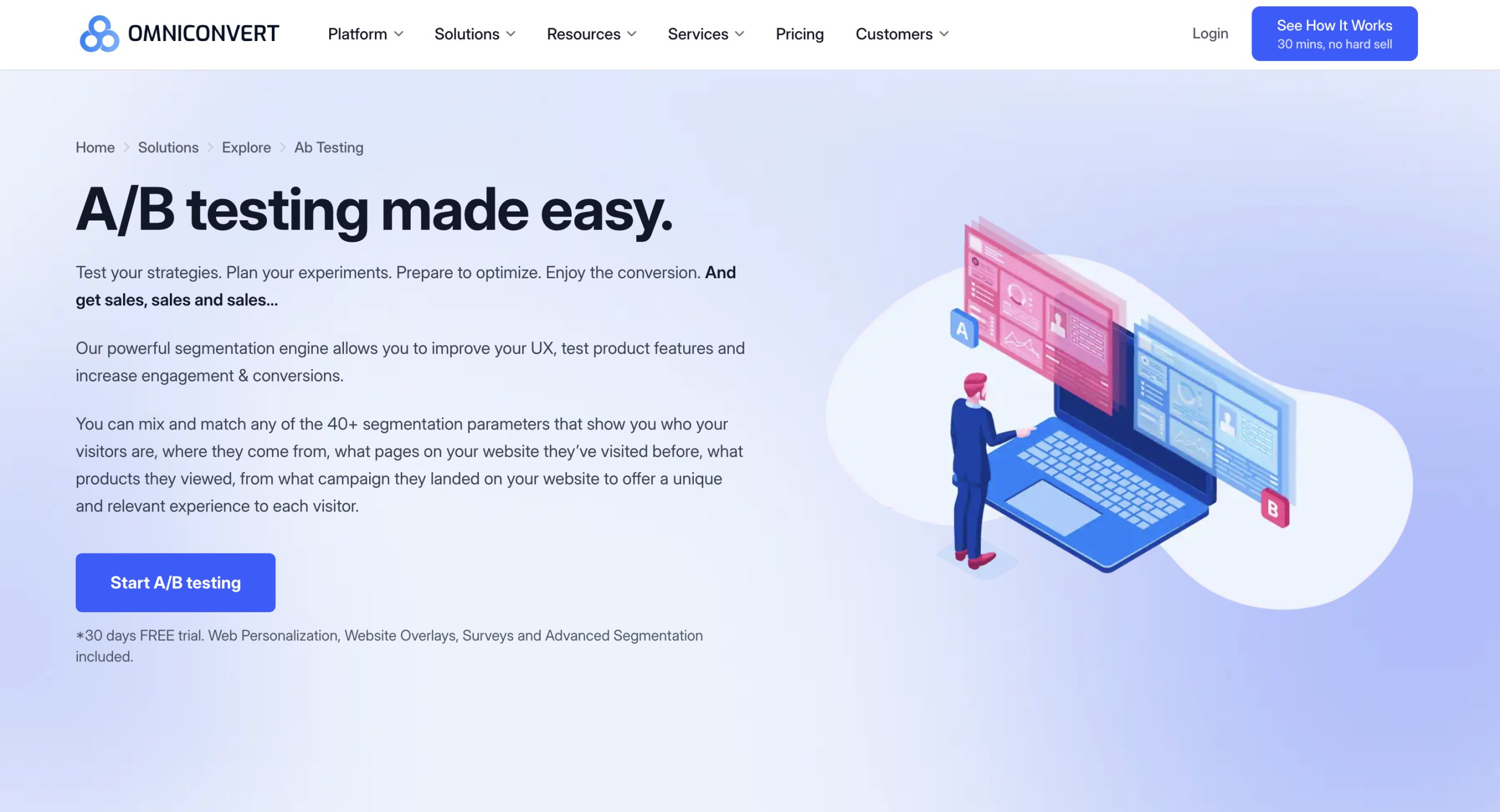
Omniconvert Explore combines A/B and multivariate testing with personalization by customer segment, all without developer support.
For Shopify stores, it pairs with Omniconvert Commander, an AI growth engine that uses RFM and CLV segmentation to rank opportunities by profit and builds campaigns for your approval.
Apart from testing, Omniconvert also enables you to run surveys, gather feedback, and analyze customer sentiment for each audience segment.
Key features
- A/B and Multivariate testing
- Personalization by customer segment
- On-site surveys and NPS (Pulse)
Pricing
A free plan covers up to 50,000 tested visitors per month with the full Explore feature set. Paid plans scale with monthly tested users.
Going forward
A/B testing is how teams move from guesswork to consistently improving performance. The right tool should help you run experiments quickly, offer reliable results, and help you scale what works across campaigns.
Platforms like Wingify combine ease of use with robust experimentation, and with Wingz, AI can help plan and build your tests while your team keeps the final say on what goes live.
If you’re evaluating tools, the next step is simple: get in touch to explore how Wingify can help your team make decisions with confidence and clarity!
Frequently asked questions (FAQs)
If your marketing team runs tests without developer support, a strong no-code visual editor is non-negotiable. Tools like Wingify are built specifically for this. If you’re running experiments on landing pages tied to paid campaigns, you need a testing platform that integrates cleanly with your ad channels and analytics stack.
Yes, there are a few no-code tools with free plans or trials, as well as some free or open-source options. These are useful for running basic tests, such as landing page copy or CTA variations, without developer support. However, most tools with free plans have limitations in targeting, statistical depth, scalability, and integration. Bottom line: Free no-code tools are a good starting point, but to run reliable, large-scale experiments and cover every aspect of conversion rate optimization, teams typically need a more robust platform like Wingify.

Hi, there! I’m a Manager, Content Marketing at Wingify with 7+ years of experience in B2B and B2C marketing. I work across blogs, SEO, thought leadership, newsletters, landing pages, and a video podcast I built and manage from scratch. At Wingify, I’ve gained expertise in CRO, experimentation, user behavior research, and personalization, creating content that makes complex ideas clear and actionable. Outside of work, I enjoy experimenting with memes and short-form video on Instagram.