One of your A/B tests recently came back with no clear winner.
The team noted the result, archived the test, and moved on to the next idea in the backlog.
But “no clear winner” only describes the average, and within it are visitors who came to the page expecting different things.
Suppose the test added a reassurance message to your checkout page. It may have helped some visitors feel secure before paying, but it also slowed down visitors who just wanted to finish quickly.
So, even though the result looks flat, the change you tested affected both groups differently. That’s why a test result rarely tells the whole story on its own.
A test result combines every visitor who was part of an experiment into one number.
This would work well if every visitor reacted to the change in the same way. In practice, however, they all arrive for different reasons.
That’s how a flat result can hide groups that responded strongly to the change, and a win can come mostly from one group while others barely moved.
In both cases, the result tells you what happened across the page without showing you who it happened to.
Wingify Emotions helps you read every test by the people inside it
When analyzing test results, teams often reach for common cohorts such as device, traffic source, or new and returning visitors.
These segments are useful for seeing where visitors came from and how they browsed. But to understand who a change really worked for, you need a way to group visitors by what drives their decisions.
Wingify Emotions groups visitors by emotional needs, helping you understand the motivations that shape how they browse, compare, and make decisions.
It reads anonymous in-session behavior and assigns each visitor to one of 10 emotional need profiles in about 30 seconds. The profiles fall into two broad groups:
Rational
Intuitive
Quality
Safety
Competition
Notoriety
Change
Immediacy
Understanding
Comfort
Attention
Community
While device and traffic source describe the visit, an emotional profile points to what visitors were looking for once they arrived.
Here are three ways your team can use Wingify Emotions to get more out of every test:
1. Find the stories hiding behind the average
If the result is flat or negative, the idea is usually dropped. If it wins, it gets rolled out to everyone.
But that overlooks what happened beneath the average.
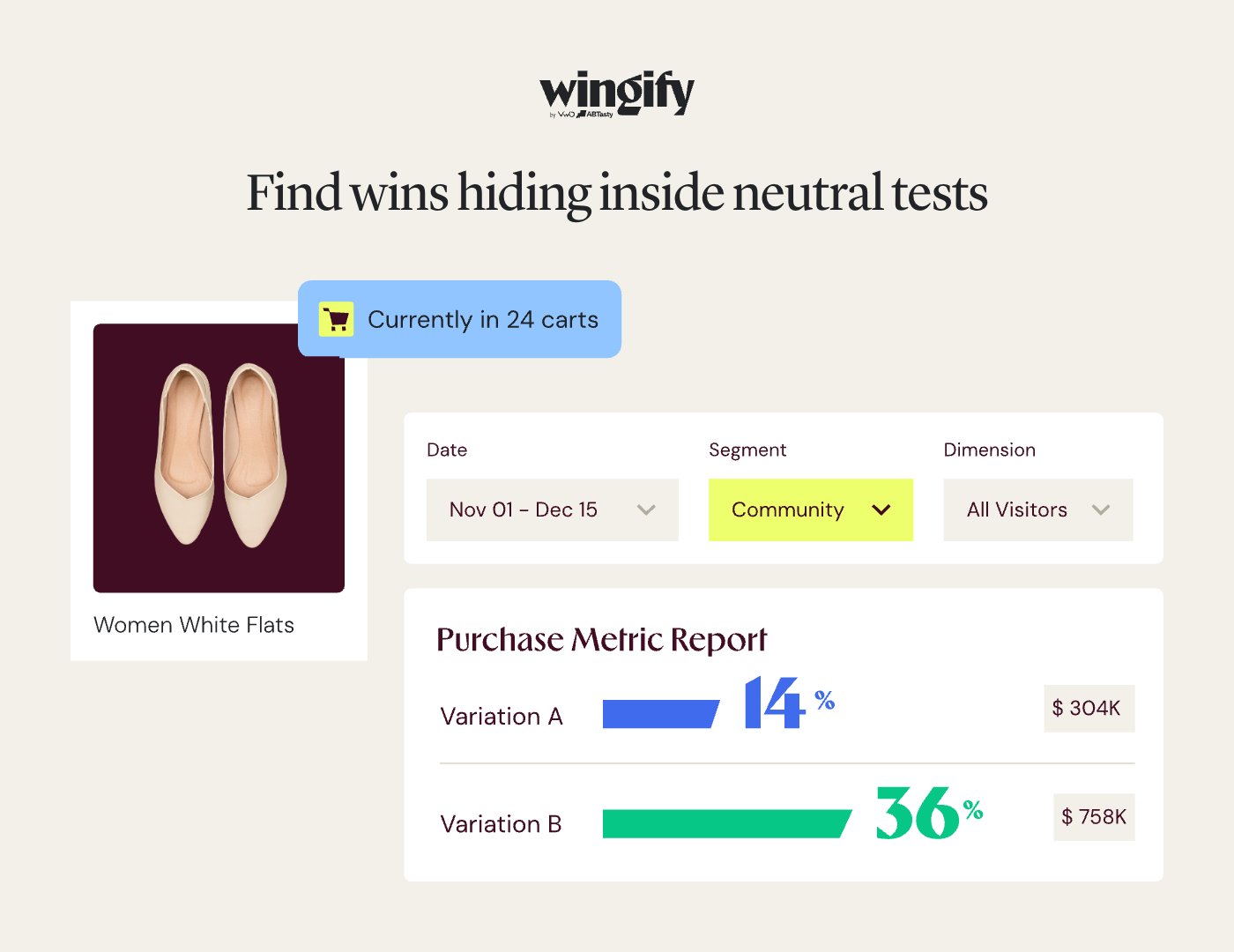
Wingify Emotions breaks down every experiment by emotional profile, revealing how different audiences responded to the same change – whether the overall result was a win, a loss, or somewhere in between.
Take a free returns message on a product page. It might increase conversions among visitors in the Safety profile, who need reassurance before buying. But for visitors in the Quality profile, who care more about product excellence, the same message might make little difference.
This kind of nuanced insight changes what your team does after a test.
If the free returns line reassures one group, you can show it to just those visitors instead of dropping the idea. For a winning test, the same breakdown helps you identify whether the win worked for every audience before you roll it out to everyone.
2. Deliver a winning experience to the audience it is relevant for
Once you know which audience a change works for, the next step is getting it in front of them.
And that is often where good ideas stall, because turning a test result into a targeted experience can mean rebuilding the variation, setting up a new audience, and waiting for another development cycle.
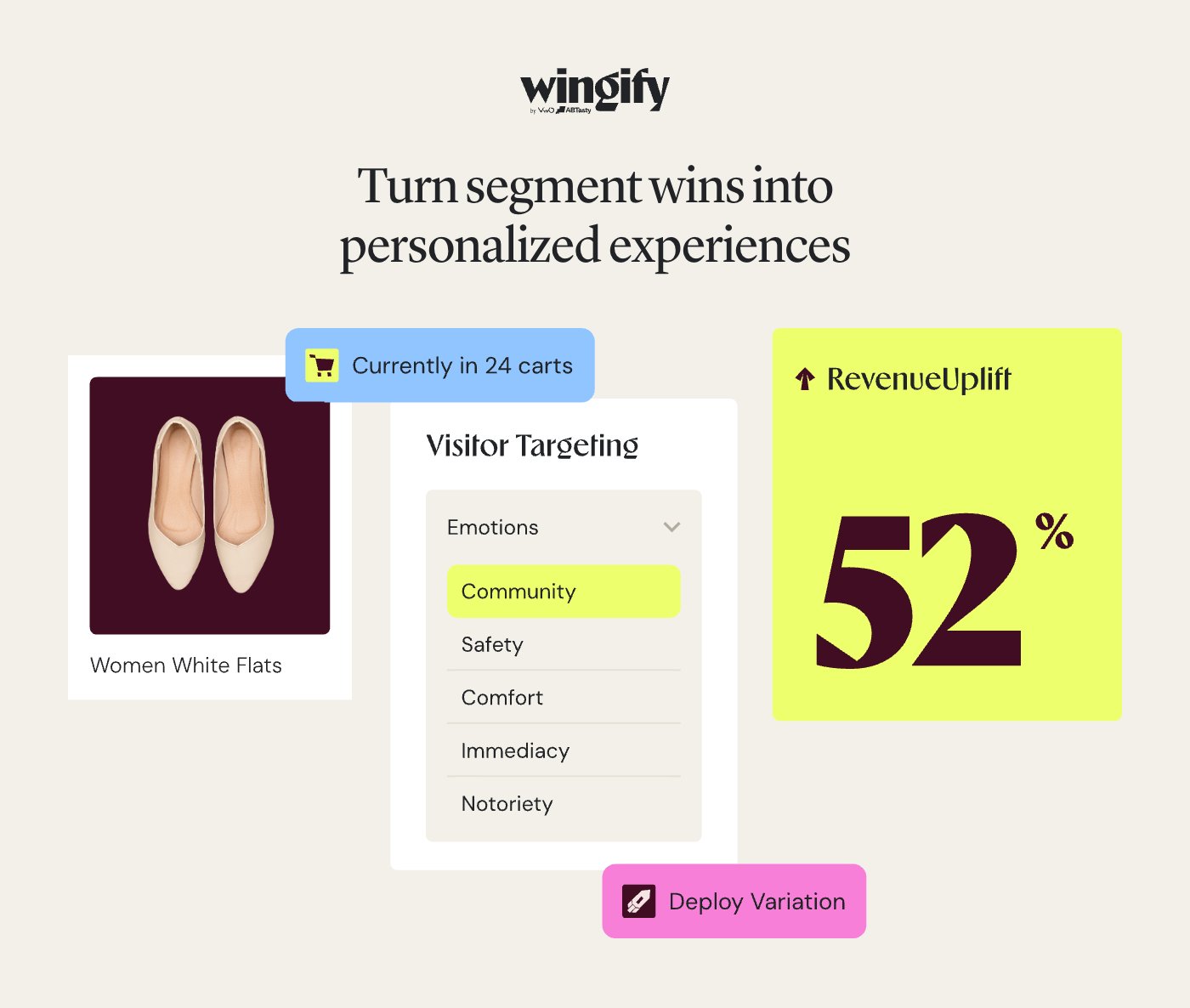
Wingify Emotions shortens that step. When a variation performs well for a specific emotional profile, you can turn it into a personalized experience for that profile in just a few clicks.
You can also make that audience more precise by combining emotional profiles with first-party cohorts, external segments, or behavioral filters, ensuring the experience reaches only the specific visitors it actually makes sense for.
For instance, a one-click checkout shortcut could go to loyalty members in the Immediacy profile, who want to act fast and find extra steps frustrating.
Loyalty members with a Notoriety profile, who trust what feels familiar and proven, could keep the standard checkout they already know.
Through all of this, your team decides which variation to promote, who sees it, and when it goes live. So instead of sitting in the archive with the tests that “didn’t work,” a good idea keeps earning from the audience it suits.
This is also where the Relevance Loop comes in: turning what you learn about visitors into decisions that shape what they experience next.
By understanding different emotional needs, deciding which experiences work best for each audience, and acting on those insights, teams can make every interaction more relevant – and keep learning from the results.
3. Plan your testing roadmap around unmet needs
Reading results by audience also changes how you plan what comes next.
Without that view, the next test is often picked by gut feel or whichever idea seems good, even when the evidence behind it is thin.
There’s a distinction I care a lot about: a test that ‘wins’ versus a test that generates real learning. The only way a result becomes a learning is if I can explain why it happened. If I can’t answer that, I don’t file it as a learning. I file it as a signal, and signals need more tests before they become knowledge.
Carlos Neto, Growth Specialist at Benner
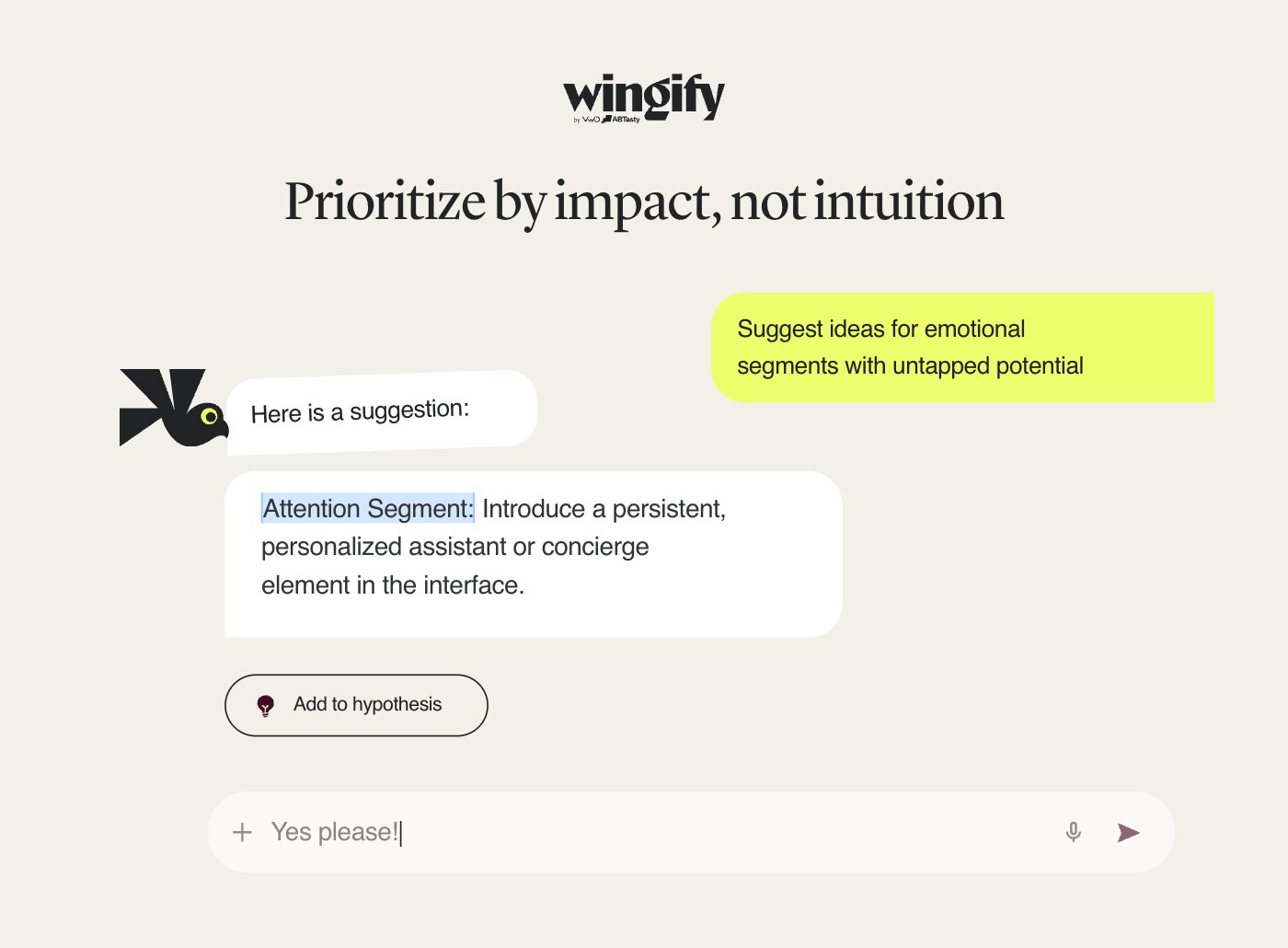
Wingify Emotions helps you decide which of those signals to follow first.
For example, you might see that visitors in the Understanding profile, who want the full picture before committing, drop off at checkout more than any other group.
This puts a sizable share of revenue at stake.
A suggested fix is to break checkout into clearly labeled steps with a progress indicator. Your team can then decide whether that’s the test to run first.
That way, your roadmap starts with the audiences that have the most room to grow, backed by evidence about what they need.
To see which parts of the customer journey other teams tend to overlook, explore our State of Experimentation 2026 report, which benchmarks 108 organizations.
Teams that put emotion-based insights to work
Groupama
Groupama, a multinational insurance group operating in 10 countries, wanted to adapt its experiments to its customers’ unique emotional needs.
The team started with its quote form. Instead of changing the form for everyone, it used emotional profiling from Wingify Emotions to tailor the experience to each group:
Visitors in the Intuitive group saw a message reassuring them that their private data would be protected.
Visitors in the Rational group saw the form without the extra message, so they could continue without distraction.
Within two weeks, quote submissions rose by 10%, and passage to the next step of the form increased by 2 points, nudging customers further through the funnel.
DirectAsia lifted access to its quote page by up to 14.8%
DirectAsia, a car and travel insurer in Singapore, had identified its car quote page as one of the top pages for conversion losses. On this page, the purchase journeys often stretched over several days.
Using emotional profiling, the team found that the need for reassurance was the most unmet need on that page.
Rather than redesigning the page for everyone, the team tested two reassurance banners shown only to those visitors who displayed this unmet need.
When you read results by emotional profile, more of your tests lead to something your team can act on, and each one tells you more about what your visitors need.
That shows up in the numbers leadership watches, from revenue per visitor to how quickly your program learns.
Wingify Emotions gives your team a clearer view of every test, while your team stays in charge of what to do with it.
Curious what your last test was hiding? Get in touch to see how you can break down a test by your visitors’ emotional needs.
Hi, there! I’m a Manager, Content Marketing at Wingify with 7+ years of experience in B2B and B2C marketing. I work across blogs, SEO, thought leadership, newsletters, landing pages, and a video podcast I built and manage from scratch. At Wingify, I’ve gained expertise in CRO, experimentation, user behavior research, and personalization, creating content that makes complex ideas clear and actionable. Outside of work, I enjoy experimenting with memes and short-form video on Instagram.