Large enterprises accounted for 61% of CRO software market revenue in 2025, driven in part by the scale and complexity of their digital operations. With multiple customer journeys, large data volumes, and dedicated conversion optimization teams, enterprise CRO demands go well beyond basic testing.
CRO platforms serving these organizations need capabilities that match this scale. Advanced testing, behavioral analytics, personalization, server-side experimentation, integrations, governance, security, and scalability all become part of the same optimization infrastructure.
The following sections examine these key enterprise CRO features and the role each plays as optimization expands across the organization.
What makes CRO software enterprise-grade?
Enterprise CRO software is built to run optimization reliably at scale. This means infrastructure that maintains statistical rigor across high traffic volumes and concurrent experiments, deep integration with an existing tech stack, and a support and compliance posture built for enterprise procurement, not a self-serve trial.
The distinction is not how many features a platform offers, but how reliably those capabilities perform as the experimentation program scales.
Key features for enterprise conversion rate optimization platforms
When you evaluate CRO tools for enterprise use, look beyond feature availability. Assess whether each capability can support your traffic, experimentation complexity, and team structure, and whether it integrates effectively with the rest of your technology stack.
Advanced A/B and multivariate testing
Enterprise testing tools need to support A/B, split URL, and multivariate tests across multiple properties, audiences, and experiments while maintaining reliable results as traffic and testing volume increase.
What to evaluate:
Supported experiment types and traffic allocation controls
Documented statistical methodology and statistical confidence
Sample ratio mismatch (SRM) detection and other statistical safeguards
Support for concurrent, overlapping, and mutually exclusive experiments
Ability to maintain experiment performance and reliable traffic assignment at high traffic volumes
Ability to scale testing across multiple websites, apps, markets, or business units
Wingify Experimentation supports A/B, multivariate, and split URL testing across digital experiences through both a visual and a code editor. Its Enhanced SmartStats engine uses Bayesian-powered sequential testing and experiment health checks (such as sample ratio mismatch (SRM) to help teams identify issues that could affect result reliability.
Pro Tip!
Wingify Experimentation lets teams group experiments into mutually exclusive campaigns, ensuring visitors exposed to one are excluded from the others. This helps prevent overlapping test exposure and keeps attribution clear across concurrent experiments. Watch the video to see how to set up mutually exclusive groups.
Feature management across the feature lifecycle
As enterprise teams release features across multiple products, environments, and user groups, they need to manage exposure, minimize release risk, and understand the impact of changes.
What to evaluate:
Progressive and percentage-based rollouts
Audience targeting and feature access controls
Impact monitoring after release
Quick rollback capabilities
Experimentation and personalization within the feature lifecycle
SDK support across web, mobile, and backend environments
Support for mobile app testing and feature releases
Wingify Feature Management brings feature flags, progressive rollouts, experimentation, personalization, mobile app testing, and AI-powered analysis into one workflow. Teams can understand feature adoption and business impact, identify what is working, and make data-driven decisions about how and when to scale releases.
Behavioral analytics
Test results show which variation performed better; behavioral analytics adds context about how visitors interacted with those experiences. Heatmaps, session recordings, funnels, and form analytics can also surface friction before testing, helping teams build stronger hypotheses.
What to evaluate:
Heatmaps, click maps, scroll maps, and session recordings
Funnel and form analytics
Ability to analyze behavior in the context of experiments
Ease of moving from behavioral insight to hypothesis and test
I let qualitative insights spark the questions and quantitative data size the impact. I watch sessions to spot unexpected behaviors, then check analytics to see how common they are and whether they affect conversion. The foundation of the testing program should be the linear path of research, observation, hypothesis, and solution. Without a solid, measurable hypothesis pulled from research, you’re asking for your testing program to be derailed.
Jono Matla, Founder at Impact Conversion (Source:CRO Perspectives)
Wingify Analytics helps enterprise teams understand user behavior, identify friction across pages and journeys, and build stronger hypotheses using heatmaps, session recordings, scroll and click maps, and form analytics. Wingify User Feedback adds qualitative data through direct user feedback via surveys, bringing behavioral data and voice-of-customer insights together before experiments go live.
Real-world impact: Global energy company EDP used Analytics to identify friction across key digital journeys and Experimentation to validate improvements. Its CRO program generated over 50% ROI and a 25%+ increase in lead conversion rates within 6 months. Read the full story here.
Advanced personalization and audience segmentation
Enterprise personalization lets teams deliver experiences based on relevant audience, behavioral, and contextual attributes, rather than optimizing only for the average visitor.
What to evaluate:
Depth of audience segmentation
Rule-based and contextual targeting
Data sources available for defining audiences
Connection between experimentation and personalization workflows
Wingify Personalization helps teams understand customer behavior and context, then adapt digital experiences to make them more relevant. Its capabilities include:
Predictive Data: Uses real-time behavioral signals to predict visitor intent and affinities, helping teams deliver more relevant experiences as interests change.
Emotions: Identifies visitors’ emotional needs from in-session behavior, helping teams tailor experiences to different motivations.
Data Studio: Brings CRM contact and account data into Wingify, helping teams create more precise audiences for personalization and experimentation.
Segmentation & Targeting: Builds granular audiences using behavioral, transactional, technographic, location, and other data, helping teams target experiences more precisely.
Deep integrations and data connectivity
Experiment data becomes more useful when funnel analysis and conversion behavior connect to customer and business outcomes elsewhere in the technology stack. Integrations with analytics platforms such as Google Analytics, along with CRM, CDP, commerce, and data platforms can help teams analyze experiments beyond the immediate conversion event.
What to evaluate:
Native integrations with your existing stack
Data that can move into and out of the CRO platform
Audience-data availability for targeting
Experiment-data availability for downstream analysis and attribution
Experiment governance and collaboration
As multiple teams start testing, experiment governance becomes as important as test creation. Enterprises need controls that define who can access and manage experiments, alongside program management capabilities that help teams coordinate ideas, priorities, workflows, and learnings across the experimentation program.
What to evaluate:
Role-based access and permissions
Workspace and account organization
Approval and collaboration workflows
Centralized repository for ideas, hypotheses, and experiment learnings
Prioritization and roadmap management
Visibility into experiment ownership, status, and program impact
Wingify Program Management brings program management into the optimization workflow, giving teams a shared place to capture ideas and supporting evidence, prioritize what to test, track hypotheses through the experimentation pipeline, and retain past learnings. This helps multiple teams coordinate their experimentation roadmap while maintaining visibility into what has been tested and the program’s impact.
AI-assisted optimization and experimentation
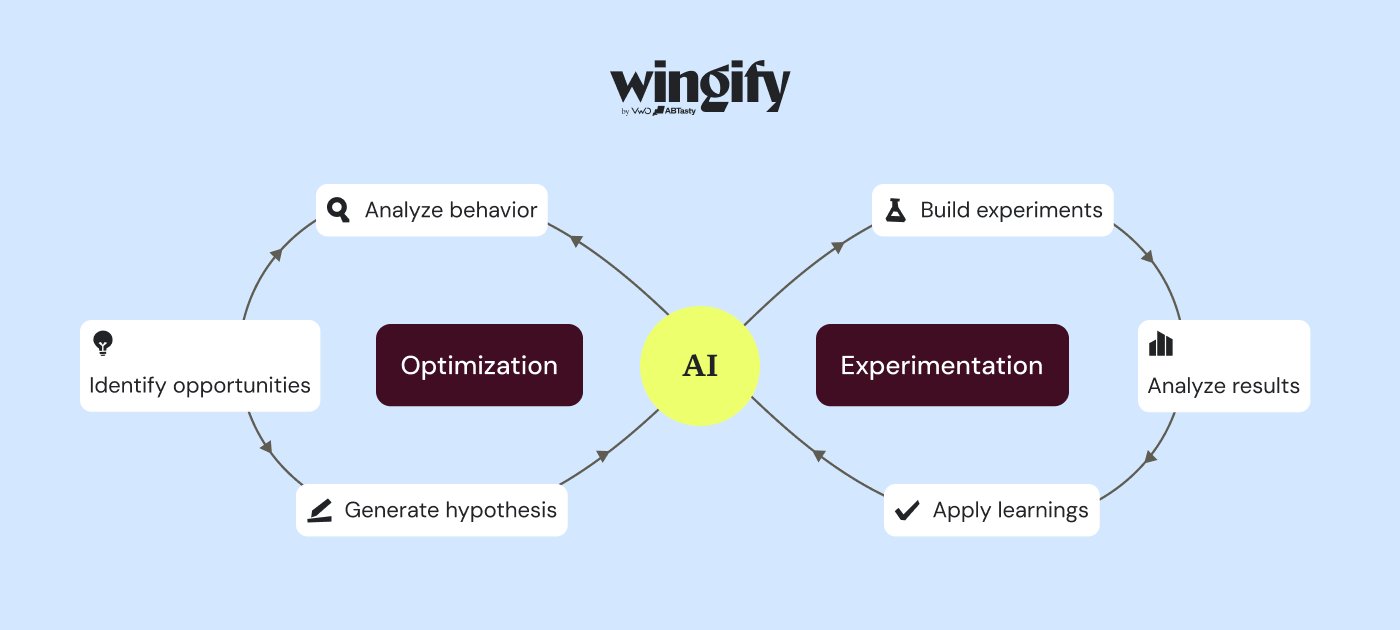
AI is increasingly used across the CRO workflow, including analyzing data from user behavior tools, identifying optimization opportunities, supporting hypothesis creation, setting up experiments, and enabling personalization.
What to evaluate:
Where AI assists the experimentation workflow and what remains under human control
Whether recommendations are grounded in actual behavioral and experiment data
AI support for analysis, hypothesis generation, content or variation creation, and personalization
Transparency around how AI-generated recommendations or outputs are produced and used
I believe that with the rise of artificial intelligence and machine learning, A/B testing will become more autonomous, capable of identifying complex consumer behavior patterns in real-time and dynamically adjusting the test variables to maximize effectiveness. Personalization will reach new heights, allowing for unique experiences that adapt to the individual preferences of each user, almost in real-time.
Taciana Serafim Noqueli de Oliveira, Product Management Analyst at Serasa Experian (Source:CRO Perspectives)
Wingify’s Wingz brings the intelligence layer across the platform, connecting context from experiments, audiences, metrics, and user behavior. Because Wingz is embedded within Wingify, it can use platform data and context rather than relying only on the generic data available to a standalone LLM.
Across workflows, it can help teams analyze behavior, identify opportunities, generate hypotheses, build experiments, interpret results, create audience segments, and support feature rollout decisions. Unlike separate AI agents focused on individual tasks, Wingz connects these capabilities so insights and outcomes from one activity can inform the next. This creates a continuous relevance loop across the optimization journey.
Security and compliance capabilities in enterprise CRO software
Enterprise conversion rate optimization tools can sit directly in the data-exposure path: they track visitors, record sessions, and often connect to CRM and customer data elsewhere in the stack. Security and compliance evaluation needs to cover that full path, not just the vendor’s headline certifications.
Capability
Why it matters for enterprises
Privacy and regulatory compliance
Support for regulations such as GDPR and CCPA helps enterprises manage consent, data collection, retention, and deletion requirements across markets.
Security certifications and audits
Independent assurance such as SOC 2 gives security and procurement teams documented evidence to assess a vendor’s security controls.
PII and sensitive-data protection
Masking and data-capture controls help prevent exposure of personally identifiable or sensitive information through heatmaps, session recordings, form analytics, and other behavior analytics tools.
Data residency and retention
Regional hosting and configurable retention policies help enterprises meet internal data-governance and jurisdiction-specific requirements.
Enterprise Governance
Single Sign-On (SSO), combined with granular Role-Based Access Control (RBAC), lets administrators safely manage permissions across internal teams and external agency partners.
Vendor and data-processing controls
Data processing agreements, subprocessor transparency, and documented data flows help legal and security teams understand how customer data is processed and shared across connected systems.
AI data governance and security
Clear policies on how AI features use customer data, prompts, and experiment data help enterprises assess data exposure, model access, retention, and whether their data trains third-party or vendor models
For enterprises operating in regulated industries, general privacy compliance may not be sufficient. Evaluate industry-specific requirements separately, including how sensitive data is handled and whether the vendor can provide the contractual safeguards your organization requires.
Wingify puts customer data security and privacy at the center of its enterprise practices. Its security and compliance framework includes independently assessed controls, data-storage options, authentication safeguards, and enterprise access controls. Its independently assessed controls include SOC 2 Type II and ISO certifications, alongside GDPR and CCPA compliance.
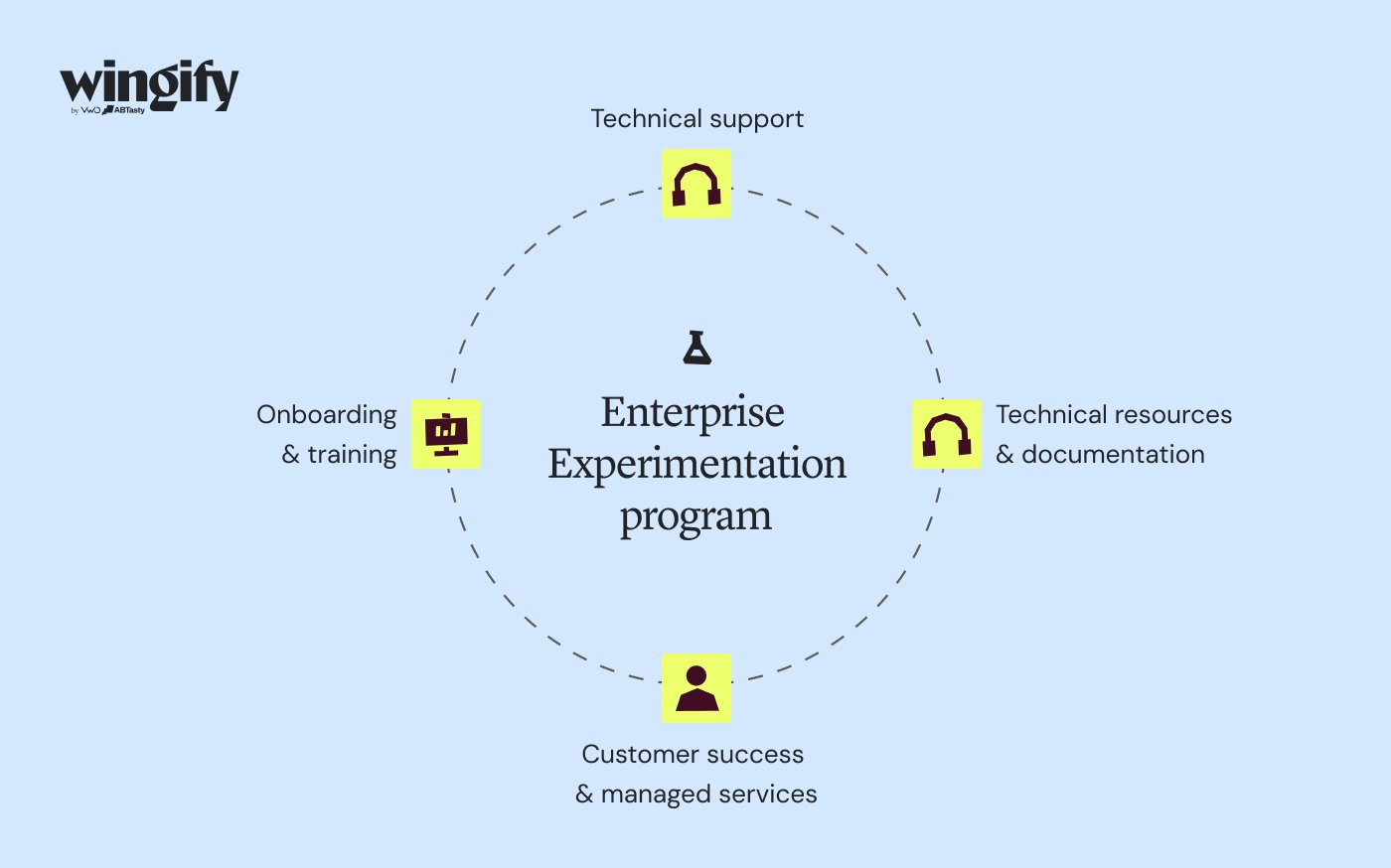
Beyond the platform: Training, support, and managed services
High-traffic organizations rarely run experimentation programs on self-serve documentation alone. What “enterprise support” includes varies significantly by vendor and tier, so it’s worth evaluating as specifically as any technical capability.
1. Dedicated onboarding and training
Structured onboarding for areas such as SDK integration, event tracking, and initial statistical configuration
Live workshops and platform certification programs tailored to marketing, product, engineering, and other participating teams
Standardized implementation and experimentation practices, rather than each team developing its own approach
2. SLA-backed technical support
Defined response-time commitments, particularly for issues affecting experiments on revenue-critical surfaces such as checkout
A named point of contact for program-level questions, separate from ticket-based technical support
Access to technical specialists for complex implementation and troubleshooting needs
3. Customer success and managed services
A dedicated customer success manager (CSM) is assigned as a consistent point of contact for the organization.
Support across activities such as hypothesis development, test implementation, QA, and post-test analysis
Particularly relevant for organizations building an enterprise experimentation program or supplementing limited internal expertise
4. Technical resources and documentation depth
SDK documentation, API references, implementation guides, product changelogs, and platform status information
Enough technical depth to support complex integrations and routine troubleshooting without requiring a support ticket for every issue
Final thoughts: Think beyond the buying checklist
An enterprise CRO platform needs more than testing capabilities. Evaluate how well it supports experimentation, behavioral analytics, personalization, feature management, integrations, governance, security, and enterprise support as your teams and digital experiences become more complex.
Wingify approaches this broader challenge through Agentic Experience Optimization, combining these capabilities on a shared foundation, with Wingz as the intelligence layer that turns customer signals and insights into action.
Request a demo to evaluate the Wingify platform against your enterprise CRO requirements.
FAQs
What is enterprise CRO software?
Enterprise CRO software helps large organizations analyze user behavior, run experiments, personalize experiences, and improve conversion rates across high-traffic digital properties. Unlike basic CRO tools, it is designed for greater scale, integration depth, security, governance, and cross-team experimentation.
What level of support and training do enterprise CRO platforms offer?
Support varies by vendor and enterprise plan, but may include structured onboarding, role-specific training, certification programs, dedicated customer success, technical support, and implementation assistance. Some providers also offer end-to-end managed services for teams that need additional experimentation expertise or execution support.
How much does enterprise CRO software cost?
Enterprise CRO software typically uses custom pricing rather than fixed public tiers. Pricing can depend on factors such as traffic volume, digital properties, experimentation requirements, selected modules, technical implementation, and the level of support or managed services required. Ask vendors for a detailed quote based on your expected usage and program scope.
Hi, I’m Pratyusha Guha, manager - content marketing at VWO. For the past 6 years, I’ve written B2B content for various brands, but my journey into the world of experimentation began with writing about eCommerce optimization. Since then, I’ve dived deep into A/B testing and conversion rate optimization, translating complex concepts into content that’s clear, actionable, and human. At VWO, I now write extensively about building a culture of experimentation, using data to drive UX decisions, and optimizing digital experiences across industries like SaaS, travel, and e-learning.
You might also love to read these on Feature Rollout
12 Min Read
Preventing Feature Release Failures: Examples, Patterns, and Checkpoints
9 Min Read
A Product Team Guide to Safe Feature Releases Using Progressive Rollouts