Will this feature increase activation? How likely are users to adopt it? Would the redesign even get noticed?
Product managers no longer have to guess the answers. Instead, A/B testing reduces that uncertainty by measuring how real users respond before changes reach everyone.
The challenge is choosing a platform that fits the way your team builds products. This guide compares the top A/B testing tools for product managers in 2026, covering their capabilities, strengths, limitations, and ideal use cases.
Why A/B testing matters for product managers
Today’s product teams can ship new features faster than ever, thanks to AI-assisted development and modern software delivery practices. But releasing features quickly doesn’t guarantee they’ll improve user engagement or other key metrics.
That’s why A/B testing has become an essential part of the product development lifecycle, helping product managers:
Evidence-based decisions: Replace assumptions and stakeholder opinions with measurable user behavior, so that roadmap decisions are backed by data rather than debate.
Reduce the cost of poor product decisions: Validate new features through feature testing and progressive rollouts using feature flags, minimizing the business impact of unsuccessful launches before a wider release.
Faster product iteration: Experiment with web and mobile app onboarding flows, pricing models, feature placement, and user journeys to continuously improve the product without committing every idea to a full rollout.
Better roadmap prioritization: Measure how different ideas influence key metrics such as activation, engagement, retention, and revenue, helping product teams invest engineering effort where it delivers the greatest impact.
Gone are the days when product managers could confidently launch a feature and move on without thorough validation. Today, the ability to precisely measure how changes affect key business outcomes is non-negotiable. Having near real-time access to customer behavior and event data is crucial—not just for evaluating the success of products and experiments but also for developing a deeper, data-driven understanding of your customers, often beyond what they consciously recognize about themselves.
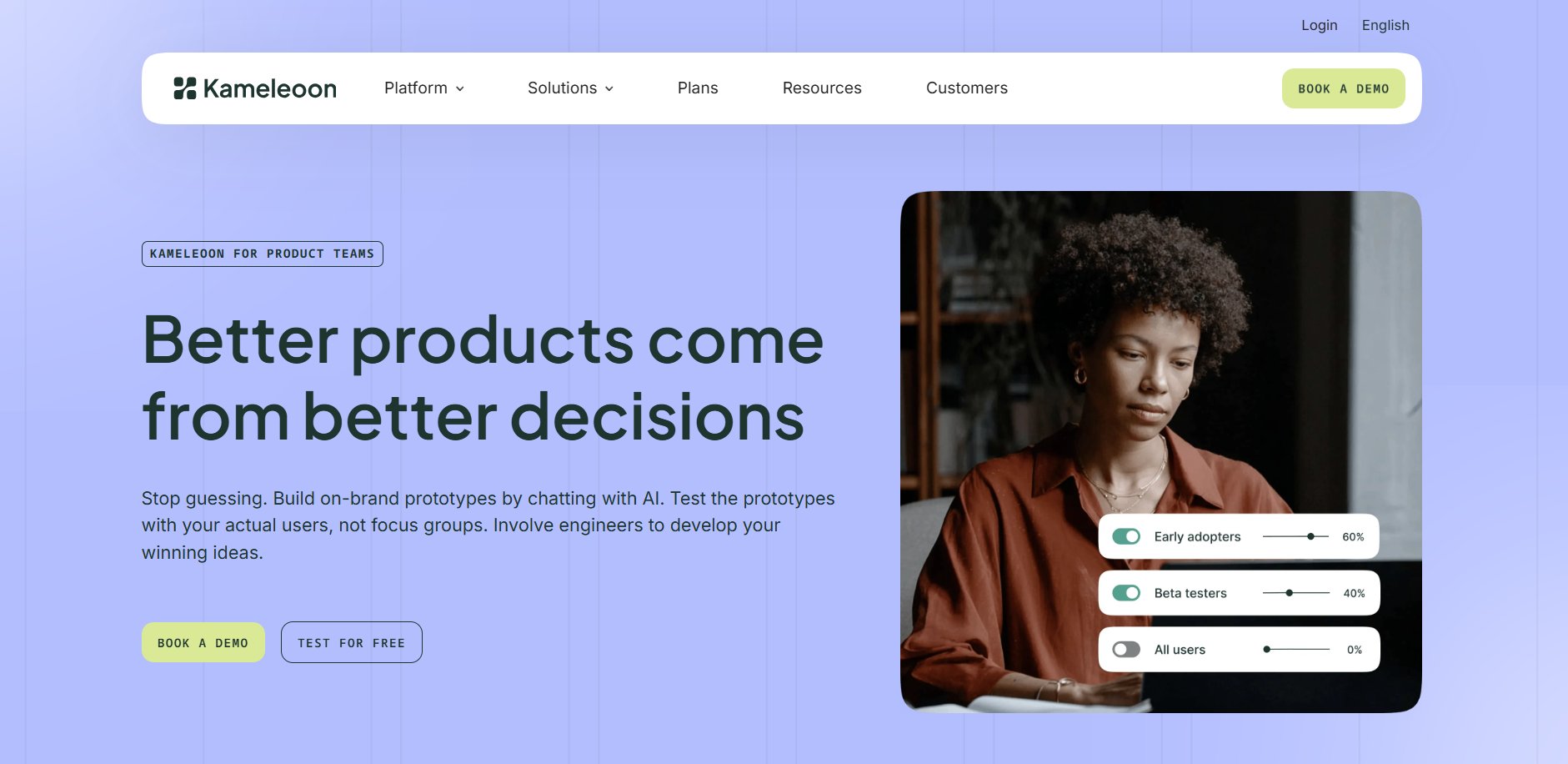
Kameleoon is an AI-powered experimentation and feature management platform that enables product managers to prototype experiences, test product flows, adoption strategies, and in-app experiences, run experiments, and gather actionable insights before investing engineering effort in full-scale implementation. It helps teams validate ideas faster, reduce release risk, and accelerate product-led growth.
Best features
Prompt-based experimentation (PBX)
Product experimentation
Server-side A/B testing
Feature management
Progressive rollouts
Advanced personalization
Bayesian and Frequentist statistical engines
CUPED and sequential testing
Holdout groups and mutual exclusion groups
Advanced audience targeting and segmentation
Native 2-way integrations
Free trial period
30 days for the PBX Starter plan
Pricing
Paid: Starts at $495/month.
Pros & Cons
Pros:
Powerful targeting options and detailed analytics simplify experiment analysis and optimization.
Cons:
Some users may find the interface and navigation less intuitive until they become familiar with the platform.
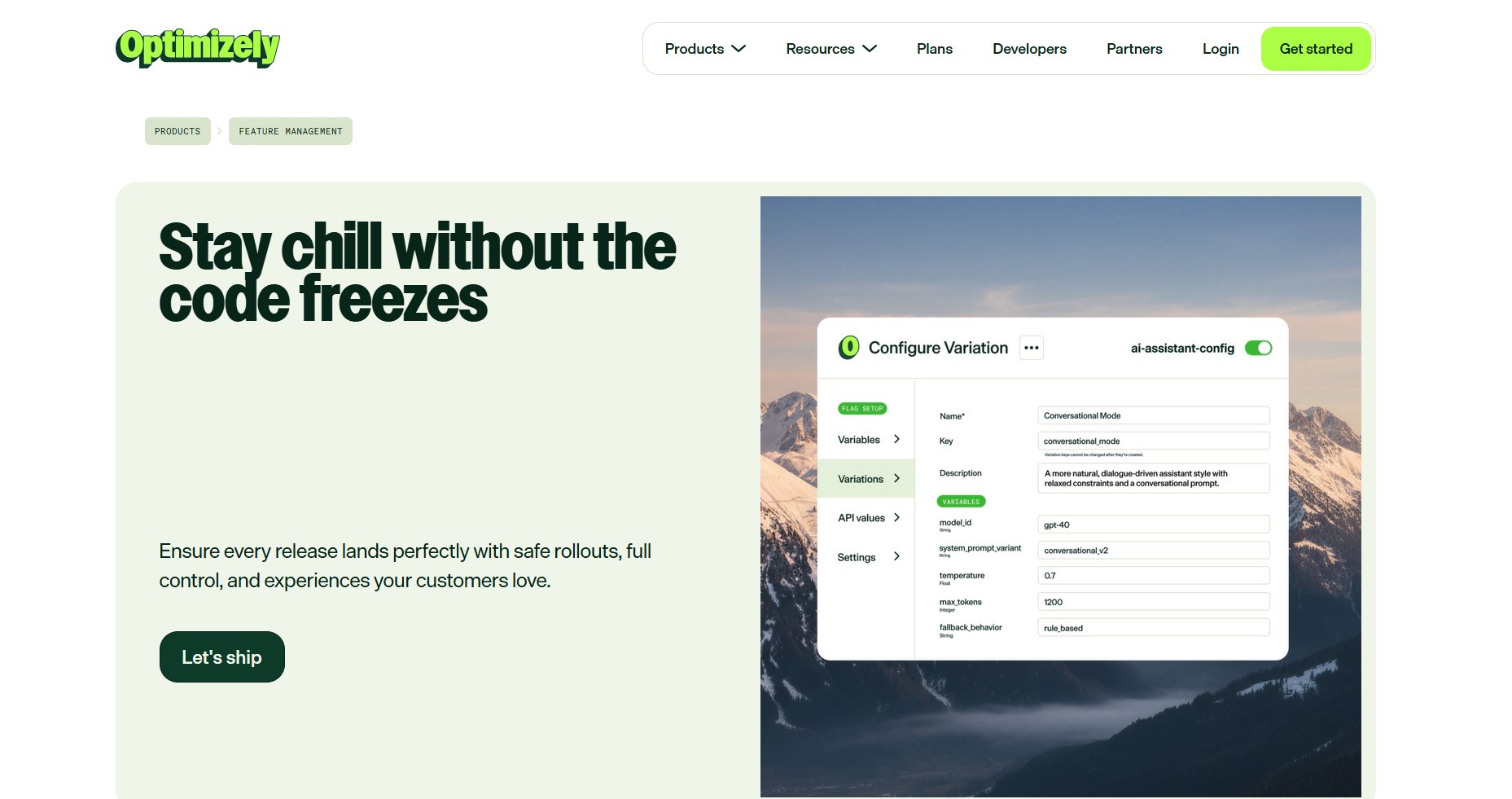
Optimizely Feature Management helps product teams safely introduce new features by validating them with real users before broad release. It combines feature experimentation and progressive delivery to support faster product iteration while minimizing production rollout risk.
Best features
Progressive rollouts
Server-side A/B testing
Advanced audience targeting
Dynamic configuration
Instant kill switch
Built-in Stats Engine
Multi-Armed Bandits (MABs)
AI-powered experimentation with Optimizely Opal
SDKs for web, backend, mobile, and edge environments
Free trial period
No free trial available
Pricing
Custom pricing available on request.
Pros & Cons
Pros:
Once implemented, the platform makes it easy to manage feature flags, variables, and A/B tests from a single interface while minimizing additional development effort.
Cons:
Implementing the platform and configuring accurate audience segmentation can require significant time and effort, even with vendor support.
Statsig is an experimentation platform that combines A/B testing, feature flags, and integrated product analytics to help product managers make evidence-based product decisions. Teams can measure feature impact, analyze experiment results, monitor rollouts, and understand user behavior throughout the product development lifecycle.
Best features
A/B and multivariate testing
No-code experiments
Feature management
Feature flags
Percentage-based rollouts
Product metrics and custom metrics
Real-time experiment reporting
Advanced audience targeting
Bayesian & frequentist
CUPED & Sequential testing
Product analytics
Session replays
Note:Amplitude has acquired Statsig and is integrating Statsig’s experimentation capabilities into its platform. Read here to understand what this means for the experimentation landscape.
Free trial period
No free trial available
Pricing
Free plan: 2M events/month for individual developers
Paid: Starts at $150/month
Pros & Cons
Pros:
Offers rich product intelligence that connects user behavior with retention, engagement, and long-term product value.
Cons:
The workflow for sharing experiments and feature gates during development could be more streamlined.
GrowthBook is an open-source, warehouse-native experimentation platform that enables product managers to run A/B tests, manage feature flags, and measure product impact using their organization’s existing data. By combining experimentation, feature management, and product analytics on a shared data foundation, it helps teams make trusted product decisions without reconciling data across multiple tools.
Best features
A/B testing
AI-powered Visual editor
Multi-arm bandits
Feature flag experiments
Split URL tests
Bayesian & Frequentist analysis
CUPED & Sequential testing
Feature management
Percentage rollout
Advanced targeting
Product analytics
Free trial period
No free trial available
Pricing
Cloud:
Free plan: Unlimited experiments, for up to 3 users (individuals)
Paid: Starts at $40/seat/month, offering advanced statistics and analytics
Self-hosted:
Free plan: Unlimited experiments and feature flags
Paid: Custom plans available on request for enterprises
Pros & Cons
Pros:
Keeps experimentation, rollout control, and analysis in one place, simplifying day-to-day product workflows.
Cons:
Some experimentation workflows have a steeper learning curve and may require technical knowledge to configure correctly.
Wingify is an Agentic Experience Optimization Platform that helps product teams turn ideas into validated decisions. By connecting customer insights, experimentation, feature management, and personalization, teams can identify friction, test ideas against real user behavior, and reduce risk before committing to wider releases. Wingz, the platform’s embedded intelligence layer, helps connect insights, actions, and outcomes across this process.
Best features
Experimentation: Run A/B, Split URL, and Multivariate tests with visual and code editors, audience targeting, and reporting to validate product and UX ideas against business outcomes.
Feature Management: Extend experimentation across the feature lifecycle with progressive rollouts, feature experimentation, personalization, and mobile app testing, giving teams greater control over how features are validated and released.
Analytics: Use heatmaps, session recordings, form analytics, Journey Analytics, and User Feedback to identify friction, develop stronger hypotheses, and understand experiment outcomes. Wingz helps surface patterns across behavioral signals and feedback to inform what to optimize next.
Other features
Automated rollbacks
Kill switches
Multi-Armed Bandits (MABs)
Mutually exclusive experiments
Holdout groups
Dynamic configurations
Post-segmentation
Personalization
Experiment program management
Download thefree ebookto master feature flags for safer product releases.
Free trial period
30-day full-featured trial is available.
Pricing
Paid: Customized MTU- based plans available on request.
Pros & Cons
Pros:
Supports rapid testing of product page experiences, enabling teams to optimize messaging, layouts, CTAs, and recommendations based on user behavior.
Cons:
Server-side implementation has a learning curve, particularly for teams managing experiments across multiple environments.
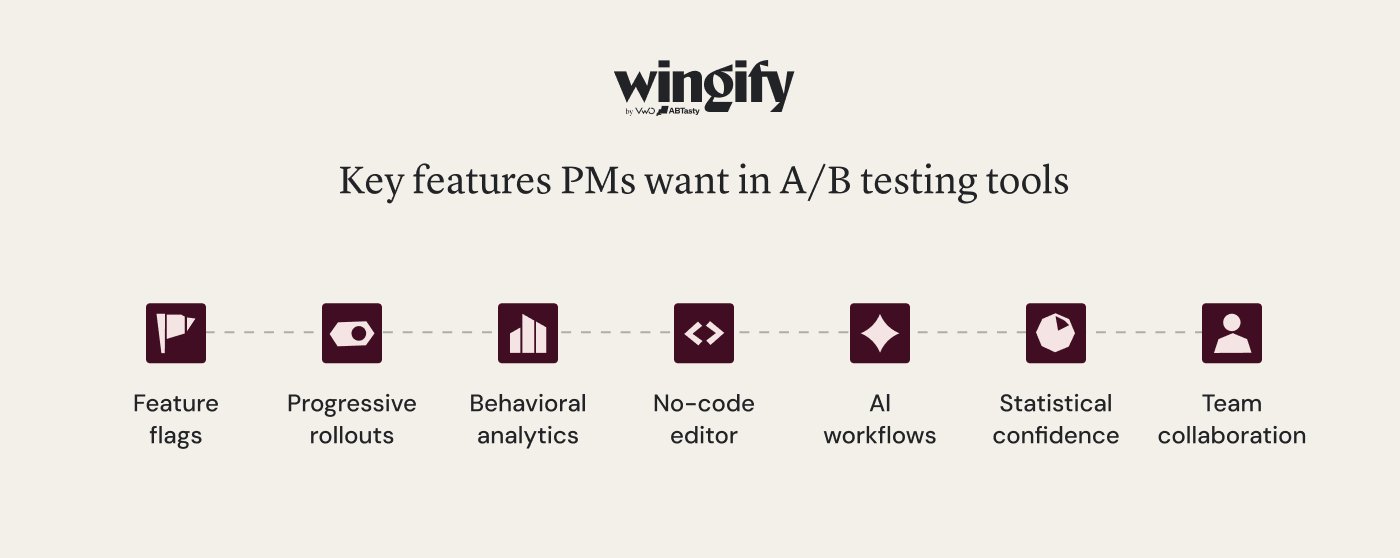
Key features PMs want in A/B testing tools
When evaluating an A/B testing tool for a product team, these are the critical, PM-specific criteria to focus on:
1. Risk containment & progressive delivery
One of a product manager’s primary responsibilities is minimizing release risk while delivering measurable product outcomes.
Granular feature flags: The tool must separate code deployment from feature release, allowing teams to enable or disable capabilities independently of deployments.
Progressive rollouts: The ability to release features gradually to increasing user cohorts helps validate performance before a full rollout.
Rapid rollbacks and kill switches: The platform should make it easy to disable or roll back features when performance or stability metrics deteriorate. Advanced platforms may also support automated rollback based on predefined guardrails.
Numbers show what is happening, but PMs need to know why and identify the next optimization opportunity.
Behavioral & product analytics: Look for platforms that connect experiment results with behavioral analytics tools such as heatmaps and session recordings, as well as product analytics, including funnels, feature adoption, user journeys, and retention analysis. Find our guide to the best product analytics toolshere.
Friction diagnostics: When a variation underperforms, the platform should help identify where users encounter friction so every experiment generates actionable product insights.
3. Non-technical operational autonomy
To maintain velocity, a product manager shouldn’t have to depend on engineering for every product experiment or UX iteration.
Robust visual editors: A dependable, point-and-click no-code editor lets product, growth, and marketing teams safely design split-URL or layout tests on production pages independently.
Dynamic configurations: The ability to modify targeting rules, audience eligibility, experiment settings, and client-side experiences without requiring engineering support for every iteration helps teams move faster.
4. Advanced AI workflows
In 2026, a modern experimentation stack should handle the heavy lifting of data analysis, allowing product managers to focus on prioritization and strategy.
AI-powered experiment discovery: Look for AI that analyzes behavioral or product data, identifies optimization opportunities, and generates experiment hypotheses.
AI-assisted reporting: AI-generated summaries should translate experiment outcomes into clear, stakeholder-friendly insights without requiring manual analysis.
Pro Tip!
Use Wingify Feature Management with Wingz AI to automate progressive rollouts and rollbacks. Start by exposing a feature to a small percentage of users, then gradually expand its reach while monitoring key metrics. Wingz can automatically scale or pause the rollout when metrics change, helping product managers catch potential issues early and make evidence-backed release decisions.
5. Guardrails and statistical confidence
PMs are constantly under pressure to share results, which often leads to “peeking” at data too early.
Safe interim reads: The platform should support interim monitoring through statistically valid methods that reduce the risk of drawing incorrect conclusions from incomplete data.
Sample-ratio mismatch (SRM) detection: Built-in automated checks that identify and flag traffic allocation issues before they compromise experiment results.
Match experimentation rigor to product stage: Zero-to-one products should prioritize learning velocity over accuracy; mature products demand careful parameters because the stakes of each change are higher. Applying the same experimentation standard across a portfolio wastes resources and slows learning.
Sourabh Gupta, SVP of Product and Design, Flip (Source: Wingify Podcast)
6. Collaboration across teams
Product experimentation is a cross-functional effort involving product, engineering, design, analytics, and leadership. The right platform should make experiments easy to coordinate, review, and learn from.
Shared experiment history: Maintain a centralized record of hypotheses, experiments, results, and learnings to avoid duplicated work.
Role-based collaboration: Permissions, approvals, and shared reporting help different teams contribute while maintaining governance.
Stakeholder visibility: Clear dashboards, integrations with analytics platforms, data warehouses, and customer data platforms, along with experiment summaries, keep everyone aligned on what was tested, what was learned, and what happens next.
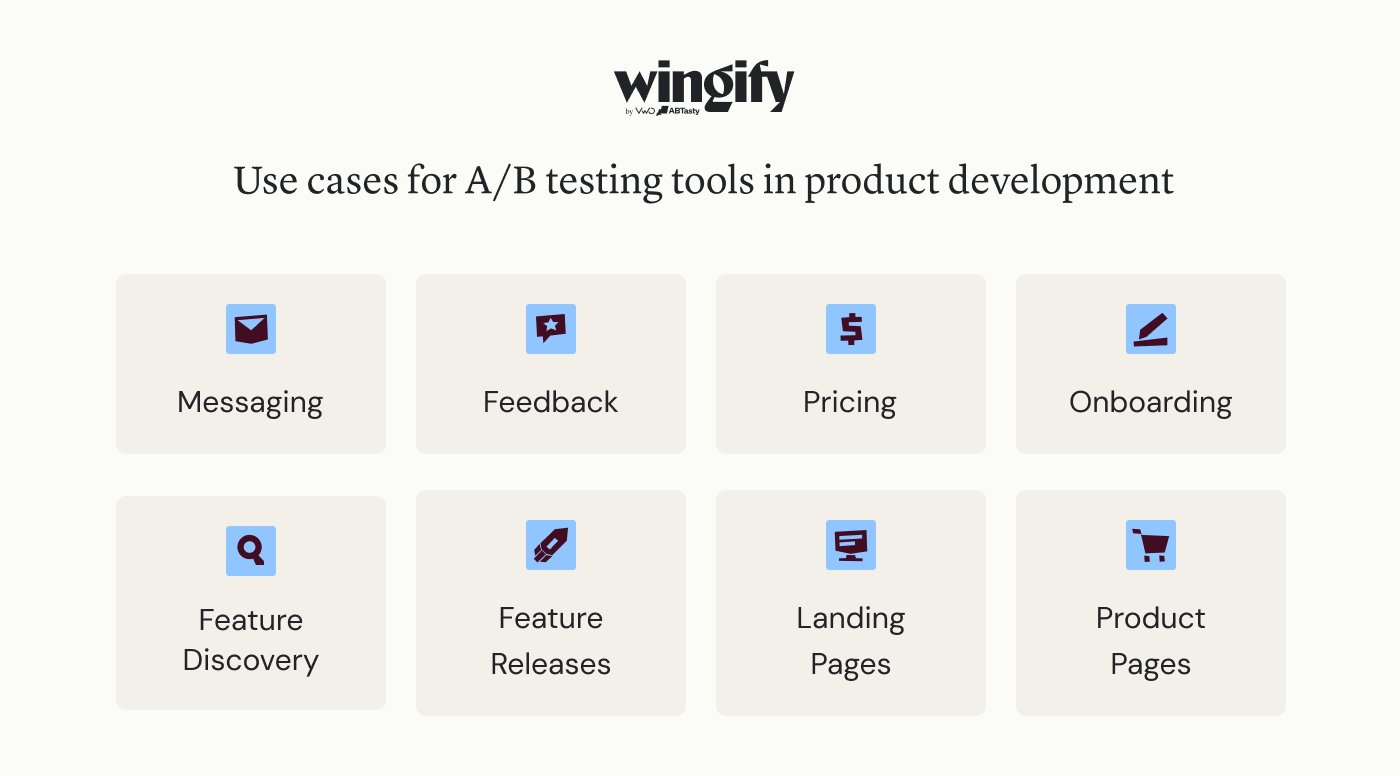
Use cases for A/B testing tools in product development
Product managers use A/B testing throughout the product development lifecycle to validate ideas, improve user experience, and reduce the risk of shipping changes that fail to deliver the expected business outcomes.
Refine product messaging: Test feature names, value propositions, and positioning statements to identify the messaging that resonates most with your target audience. CityCliqincreased click-throughs to its pricing page by 90%after testing different homepage positioning statements and discovering that a simpler, more direct value proposition resonated best with visitors.
Improve user feedback collection: Experiment with survey timing, placement, and question formats to collect higher-quality feedback without disrupting the user experience.
Optimize product pages: Test product layouts, images, feature descriptions, pricing, configuration options, and purchase journeys to improve usability, reduce friction, and increase conversions. Serpent Forgeincreased add-to-cart clicks by 82%after replacing a PayPal-only badge with multiple payment option badges, reducing confusion at a critical decision point.
Strengthen user onboarding: Compare onboarding journeys, product tours, checklists, and feature introductions to improve user activation and early retention. AURUM redesigned its onboarding experience with a guided first-time journey, progress tracking, and onboarding checklists, resulting in a300% increase in trial activationthrough continuous experimentation.
Increase feature discovery: Test different announcement banners, tooltips, pop-ups, and in-app prompts to encourage users to discover and adopt new features. Ben NL repositioned its phone color selector after analyzing heatmaps and session recordings, resulting in a17.63% increase in conversionswhile significantly reducing customer support calls.
Validate new feature releases: Release new capabilities to a small user segment, measure their impact on adoption and key metrics, and refine the experience before a full rollout. Meliá Hotels progressively rolled out a new booking funnel step, confirming it was safe to expand from 5% to 100% of visitors after it delivered a 1.85% uplift in revenue per visitor while maintaining stable booking conversions.
Validate pricing & packaging: Experiment with subscription plans, price points, feature bundles, and pricing page layouts to understand how pricing changes affect conversions, customer lifetime value, and revenue. For example, Server Density used A/B testing to compare usage-based and packaged pricing, resulting in a114% increase in revenuedespite a decline in free trial sign-ups.
Conclusion: Build products. Validate every decision.
Every product roadmap is filled with ideas, but ideas alone don’t improve products. Product managers make dozens of decisions across onboarding, feature development, pricing, and user experience, each carrying the potential to influence activation, retention, and revenue.
That makes choosing the right A/B testing platform an important product decision. The right platform supports every stage of the experimentation process, from understanding user behavior and generating hypotheses to validating feature releases, measuring business impact, and sharing insights across teams.
If you’re ready to make experimentation a core part of your product development process, request a demo for the Wingify platform and see how it helps teams understand user behavior, validate product decisions, and continuously improve digital experiences.
FAQs
What mistakes should PMs avoid when using A/B testing tools?
PMs should avoid running split tests without a clear hypothesis, ending experiments too early, focusing only on vanity metrics, running overlapping tests on the same audience, and making decisions without statistical significance. Also, validate experiment tracking before launching to ensure reliable results.
How do I choose the right tool for my team?
Choose a tool based on your product maturity, technical resources, and experimentation goals. Consider factors such as client-side and server-side testing capabilities, feature flags, Google Analytics integrations, ease of use for non-technical users, statistical capabilities, collaboration features, and pricing.
Which A/B testing tools are best for PMs?
The answer depends on how your team builds and ships products. Some teams only need experimentation, while others need a platform that also supports feature rollouts, user behavior analysis, and personalization. Wingify brings all of these capabilities together, making it a comprehensive solution for product teams.
Hi, I’m Pratyusha Guha, manager - content marketing at VWO. For the past 6 years, I’ve written B2B content for various brands, but my journey into the world of experimentation began with writing about eCommerce optimization. Since then, I’ve dived deep into A/B testing and conversion rate optimization, translating complex concepts into content that’s clear, actionable, and human. At VWO, I now write extensively about building a culture of experimentation, using data to drive UX decisions, and optimizing digital experiences across industries like SaaS, travel, and e-learning.
You might also love to read these on Feature Rollout
11 Min Read
Key Features for Enterprise Conversion Rate Optimization Platforms
12 Min Read
Preventing Feature Release Failures: Examples, Patterns, and Checkpoints
9 Min Read
A Product Team Guide to Safe Feature Releases Using Progressive Rollouts