There’s something fitting about standing in a science museum to talk about running shoes. After all, both are exercises rooted in experimentation – where one tests hypotheses about the physical world, and the other about the people moving through it.
At Experience Next Amsterdam, which took place at the NEMO Science Museum – Andrey Prokhorov, who leads ASICS’ e-commerce optimization team, raised a similar sentiment. In experimentation, the goal isn’t just to move fast – but to move in the right direction.
A brand built on a pure philosophy
Cementing its name as one of the fastest-growing footwear brands, ASICS has blossomed in the world of sports brands – primarily being known for designing footwear and apparel for athletes on every level.
ASICS found the inspiration for its name in the acronym Anima Sana In Corpore Sano, which roughly translates to “a sound mind in a sound body” – a philosophy the brand embodies into every product and digital experience it builds.
Andrey Prokhorov, who serves as the Digital Experience Optimization Manager at ASICS EMEA, has spent almost four years leading e-commerce optimization at the footwear company – with his most recent work being with a broader digital experience optimization team that reaches into omni-channel to bring those same great digital experiences into retail.
The challenge: you only get one shot
The problem Andrey put on the table is one every optimization team can empathize with: having a crucial problem to pinpoint and solve, but only having one shot at solving it.
Imagine you’re dealing with a genuinely important consumer problem: not something as simple as the color of a button, but something much bigger and more complex – and you only get one opportunity to get it right.
Naturally, to gear up for the game at hand, you’d do your homework – from user interviews, desirability studies, to a full toolkit of UX research. You’d design a beautiful solution, build it, launch it, and hope it lands – but where’s the guarantee?
However experienced your team is, there’s no foolproof way to know how consumers will perceive your experience – and the odds of getting it right on the first attempt are slim.
Data backs up this exact ideal. Referring to a seminal paper written by former Microsoft employees, Andrey noted that only about one third of the experiments in Microsoft’s program actually improved the metric they were designed to move. Basically, even if you get a chance to improve upon an existing concept – there’s a two-thirds chance that it won’t even work.
This is where Wingify can step in to boost your confidence and help your team shoot its shot.
Speed vs. velocity
At this point in his presentation, Andrey drew a distinction that reframed the whole conversation. Speed is how fast something moves, and volume is simply the number of tests you run – but velocity is speed with a direction.
Many teams chase speed or volume – striving to run more tests and launch more often. But volume alone is a trap. While it’s a useful health metric, it shouldn’t be your sole, guiding light.
What you actually want is velocity: which refers to meaningful learning cycles divided by unit of time. The “meaningful” part up to each business to personally define – depending on whether your goal is to achieve greater revenue, gain new insights, or simply uncover fewer unknowns about your consumers.
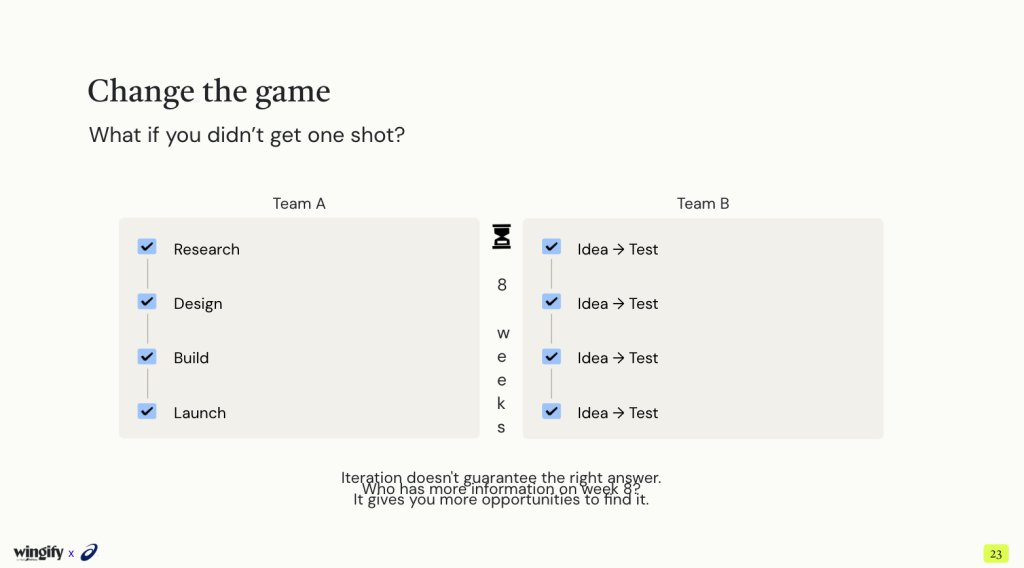
To illustrate this, Andrey delineated the differences between two teams over the course of eight weeks. Team A does deep research, designs a polished experience, and launches it. Team B iterates faster and runs multiple tests. While neither outcome is guaranteed, odds are that Team B ends those eight weeks having learned more – having tested more ideas and gaining greater insights to build on.
Over time, those ideas compound, ultimately reducing uncertainty and raising the odds of delivering a genuinely relevant experience.
From a single test to an entire operating system
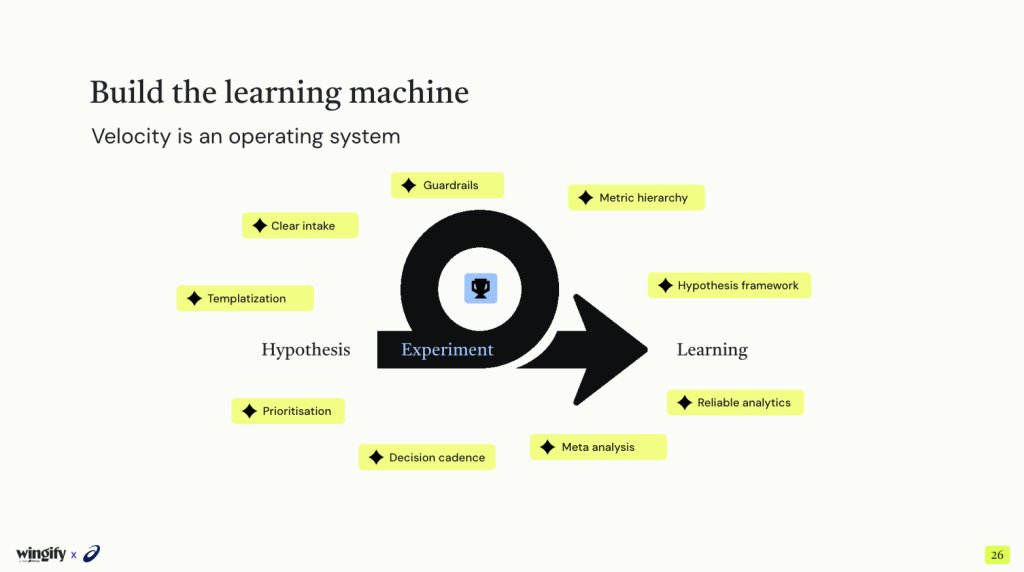
Crucially, velocity doesn’t just mean “run more tests.” It’s an operating system, and like any well-oil machine – it needs more than just the basics of a hypothesis-design-build-measure loop. It needs a clear intake for prioritization, high-quality insights, a hypothesis framework, and a clear line connecting inputs to outcomes.
When those pieces are put in place and supported by a platform like Wingify, velocity stops being a slogan – and starts becoming how the team works in real-time.
Putting it into practice: the cart page
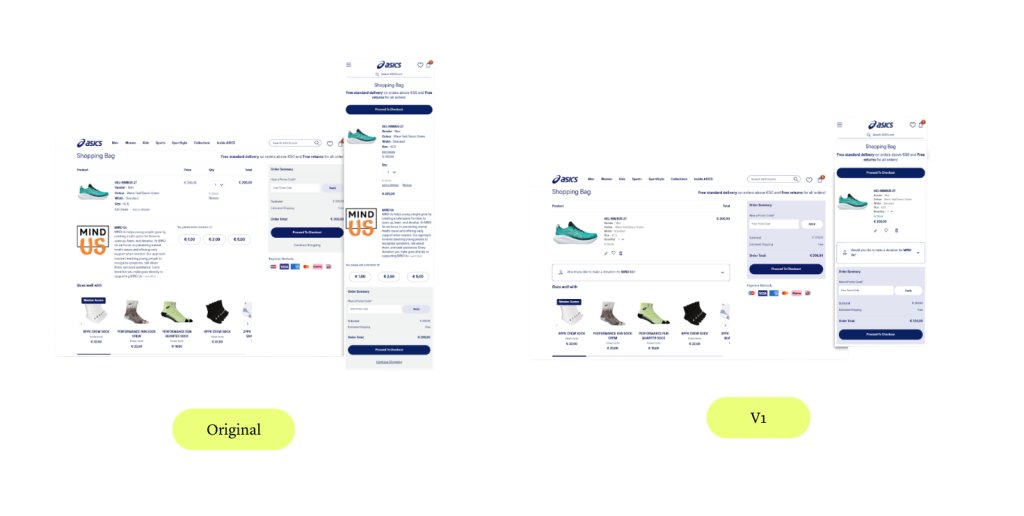
ASICS proved its point by redesigning its cart page. Research revealed that the old layout was too distracting. Instead of an elaborate redesign, the team took an iterative approach – running a series of tests before bringing the new experience to market. The results varied: a donation item test was impressively positive, an order summary component test was inconclusive, and a sticky CTA test came back negative.
That mix mattered. Had ASICS gone live with the redesign in a single shot, they would’ve most likely shipped the sticky CTAs – which was their original plan, backed by both qualitative and quantitative insight – and would’ve never discovered which of the many changes actually moved the needle.
Instead, their continuous approach let the team refine along the way, achieving a final redesign fuelled by granular insight. It performed well, the cart page stayed, and when ASICS later migrated platforms – the new layout was largely built on that successful experiment.
The takeaway: your perfect shot is a combination of practice and patience
ASICS’ message is refreshingly practical: experiment as much as you can, and use split testing wherever possible – as it’s the gold standard for a reason. But when a perfect first attempt isn’t realistic, the answer isn’t to aim harder – it’s to exhibit patience, swiftly gather as much information as possible, and let the learning compound.
Because in the end, the perfect shot is rarely a single shot. It’s the sum of all the smaller practice shots you gave yourself time to take – and that’s how you can truly hit the ground running.

Stephanie Safdie holds a bachelor's degree in English Language and Literature from the University of Maryland, specializing in multimedia studies. She has worked as a social media video creator, freelance copywriter, SEO copywriter at Greenly climate tech, and runs a travel blog Destination Dreamer Diaries.