If you’ve ever looked up A/B testing advice online, you’ve probably noticed a massive trend that most of it focuses on eCommerce. Changing a checkout button from blue to green, optimizing a product image gallery, or tweaking a limited-time discount banner.
But running a SaaS business is a completely different ballgame. You aren’t trying to convince a user to make a one-off, impulse purchase of a T-shirt. You are trying to convince them to integrate your software into their daily workflow, change their habits, and commit to a recurring subscription.
Because the subscription business model changes what success looks like, your experimentation strategy needs to evolve too. In this guide, we’ll compare the leading platforms and explain what to look for when evaluating them.
What makes A/B testing different for SaaS businesses
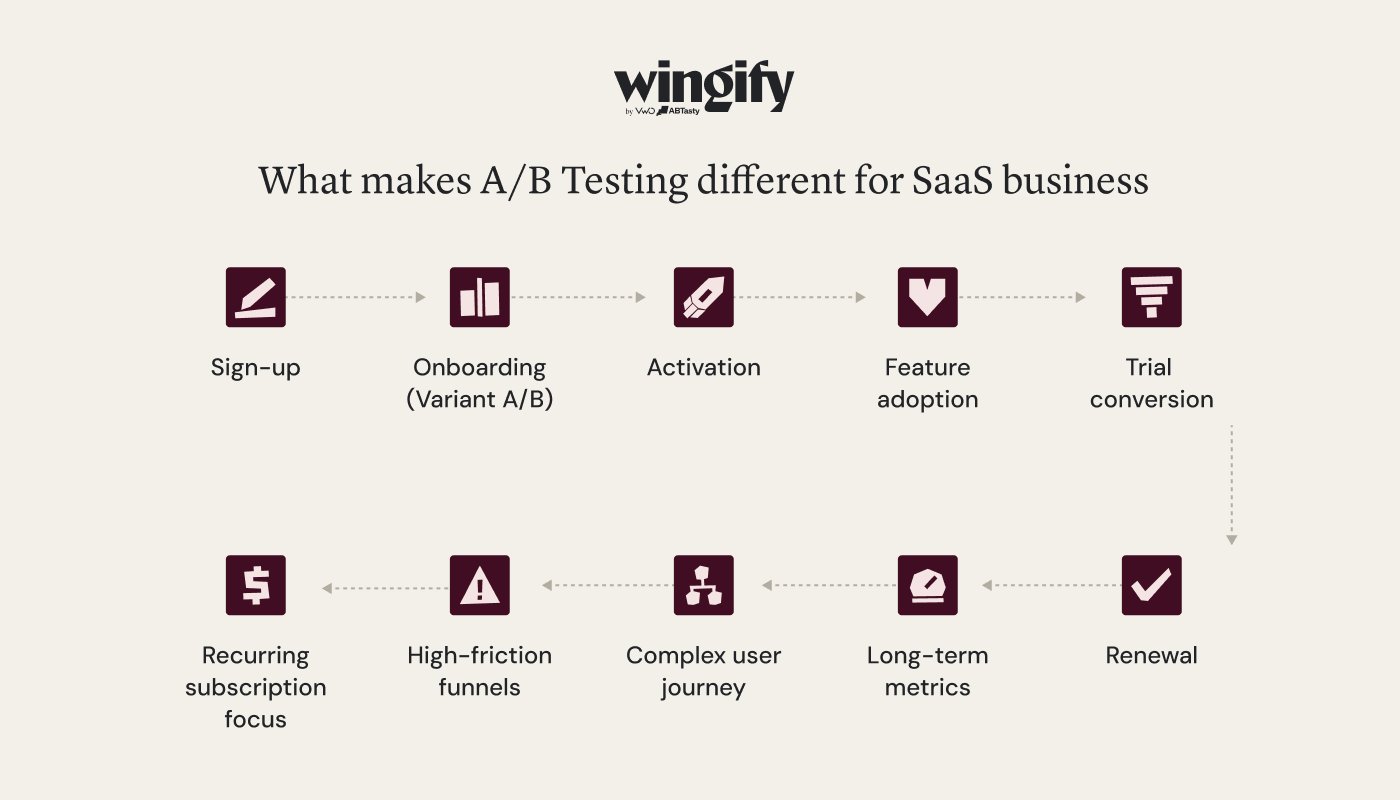
While the fundamentals of A/B testing remain unchanged, the context in SaaS changes significantly. Here is what sets SaaS A/B testing apart from traditional testing:
1. You are optimizing high-friction, multi-step funnels
In eCommerce, the funnel is relatively linear: landing page, product page, cart, checkout. SaaS journeys are far more complex. Users move through sign-up, onboarding, activation, feature adoption, paid conversion, and eventually renewal.
The goal isn’t simply to get users to sign up; it’s to help them reach their first value moment as quickly as possible. A friction point midway through onboarding can significantly reduce activation and, ultimately, user retention. That’s why every experiment should be evaluated based on its position in the customer journey, not just on its immediate conversion rate.
2. The focus shifts from conversions to retention & LTV
A standard A/B testing tool can tell you whether Variation B generated more clicks or sign-ups than Variation A. For SaaS businesses, however, those are only leading indicators.
If Variation B generates 20% more free-trial sign-ups but fewer users activate, or they churn before renewal, the experiment hasn’t improved the business; it has simply shifted the problem further down the funnel.
SaaS teams need to evaluate experiments against downstream metrics such as feature adoption, customer retention, and customer lifetime value (LTV), not just the first conversion event.
Related reading: Learn howcustomer retentionstrategies and continuous experimentation work together to improve long-term SaaS growth.
Also, watch thewebinarto explore how leading SaaS companies optimize the customer journey after sign-up.
3. Experimentation extends beyond the website
Testing in SaaS doesn’t stop at landing pages or pricing tables. While pricing pages remain one of the highest-impact conversion surfaces, product teams also experiment with onboarding flows, in-app messaging, feature discovery, paywalls, search experiences, recommendation engines, and other product interactions.
Some of these experiments can be created using a visual editor, while others require server-side experimentation to validate changes deep within the application. As a result, SaaS businesses need platforms with robust experimentation capabilities that support testing across websites, products, mobile apps, and backend services, not just marketing pages.
4. Continuous shipping and feature management
SaaS products evolve continuously. Product and dev teams are continuously shipping new code, updates, and bug fixes.
Rather than exposing every user to a new feature immediately, teams often release it to a small user segment first, monitor its impact, compare it against the existing experience, and then gradually expand the rollout if the results are positive. This closely connects feature management and experimentation and requires capabilities such as controlled rollouts, feature flags, and server-side testing.
5. Experimentation is a cross-functional capability
Experimentation in SaaS is rarely owned by a single team. Marketing teams optimize acquisition and pricing pages; product teams focus on onboarding and feature adoption; engineering teams validate backend changes through server-side experiments; and growth teams measure long-term engagement and retention.
This broader scope also changes what SaaS teams expect from their experimentation stack. The capabilities that matter extend far beyond a visual editor or simple website A/B tests, a topic we’ll explore in the next section.
Want to build a repeatable feature launch process? Download our One Flag Feature Launch Playbook to learn how modern SaaS teams combine feature flags, experimentation, and gradual rollouts to reduce release risk.
Key features to look for in a SaaS A/B testing tool
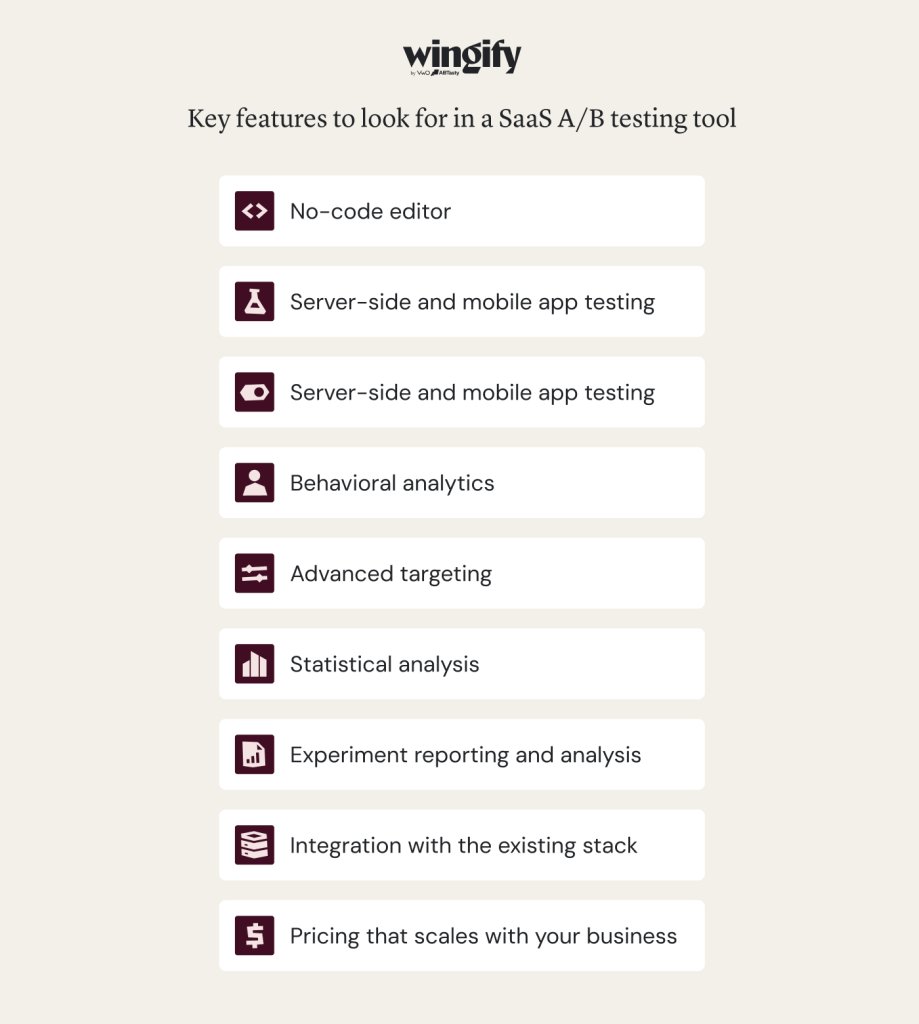
The factors discussed above point to a specific feature set. A tool can look complete on a generic comparison chart and still fail a SaaS team if it’s missing any of these:
1. No-code setup for non-technical users
Marketing and growth teams need to build and launch split tests on landing pages and pricing pages without waiting on a developer. A visual editor speeds up experimentation by reducing engineering bottlenecks, allowing teams to validate ideas quickly while reserving developer effort for more complex product experiments.
2. Server-side and mobile app testing
Testing in-app onboarding logic, subscription workflows, feature gating, pricing rules, recommendation engines, or search algorithms requires server-side experimentation, not client-side visual changes. A platform that supports both client-side and server-side testing enables product, engineering, and marketing teams to experiment within a single workflow.
3. Feature flags and controlled rollouts
SaaS products ship continuously, which makes experimentation an integral part of the release process. Feature flags let teams release new functionality to a small percentage of users, compare experiences, monitor performance, and instantly roll back changes if needed. When feature management and experimentation work together, product releases become safer and more data-driven.
4. Behavioral analytics for hypothesis generation
Strong experiments begin with strong hypotheses. Heatmaps, session recordings, funnels, form analytics, and in-product behavioral data reveal where users stall in onboarding or feature adoption, which turns a vague test idea into a specific, falsifiable hypothesis. Tools that treat this as a separate purchase add friction to the exact step where most tests originate.
Pro Tip!
Don’t investigate a funnel drop-off in isolation. Use Wingify Journey Analytics to identify where users leave the journey, then examine heatmaps or session recordings in Behavior Analytics to understand what happened before the exit. When journey data and observed behavior point to the same friction, you have stronger evidence for what to test next.
5. Advanced targeting based on user attributes and behavior
SaaS teams often need to target experiments by subscription plan, lifecycle stage, feature usage, account type, geography, or user behavior, rather than by broad attributes like device or browser.
For example, you may want to test a new onboarding flow only for first-time users, an upgrade prompt only for free-plan customers approaching their usage limits, or a feature announcement only for highly engaged users.
Granular targeting ensures experiments reach the right audience, producing more meaningful insights and reducing the risk of misleading results.
6. Reliable statistical analysis
SaaS conversion events are often lower-volume and accumulate more slowly than typical eCommerce events. Look for platforms with sequential testing capabilities and safeguards such as Sample Ratio Mismatch (SRM) detection; these prevent false positives and give teams confidence to act on results.
7. Experiment reporting and analysis
A winning variation isn’t always the one with the highest conversion rate. SaaS teams need reporting that goes beyond top-line metrics to analyze experiment performance across different user segments and key business KPIs. The right platform should help you understand not just which variation won, but why it won, who it worked for, and whether the improvement translated into meaningful business outcomes.
Present the same data to two people, and they’ll talk about it differently. Data will not speak for itself. There is always a storyteller who will frame the data the way they want it heard. So you have to be very careful when presenting optimization results. We have statistically significant results, and we have results that show positive signals but without statistical confirmation. At the end of the day, it’s always the end user who decides how the data story gets told.
Mahek Mahendra Shah, Director of Product Management at Wingify (Source: Wingify Podcast)
8. Integration with the existing stack
Experimentation data becomes far more valuable when it’s connected to the rest of your technology stack. Connecting results to Google Analytics, product analytics, and CRM data allows teams to evaluate experiments alongside activation, retention, revenue, and customer lifetime value, rather than viewing test results in isolation.
9. Pricing that scales with your business
Your experimentation needs will evolve as your SaaS business grows. A platform should support everything from early-stage experimentation to enterprise-scale testing without forcing a costly migration or resetting years of experiment history.
Best A/B testing tools for SaaS: A quick list
Wingify
Amplitude
Kameleoon
GrowthBook
LaunchDarkly
5 Best A/B testing tools for SaaS
Quick comparison of the best A/B testing tools for SaaS
Tool
Best For
Web Testing
Server-Side & Feature Flags
Product Analytics
Behavioral Analytics
Ease of Use
Free Trial
Wingify
All-in-one experimentation for marketing & product teams
✅
✅
✅
✅
⭐⭐⭐⭐⭐
30 days
Amplitude
Analytics-first product experimentation
✅
✅
✅
✅
⭐⭐⭐⭐☆
❌
Kameleoon
Enterprise SaaS experimentation & personalization
✅
✅
❌
❌
⭐⭐⭐⭐☆
30 days
GrowthBook
Open-source, warehouse-native experimentation
✅
✅
Limited
❌
⭐⭐⭐☆☆
❌
LaunchDarkly
Feature management & progressive delivery
Limited
✅
Limited
❌
⭐⭐⭐☆☆
14 days
Note: Ease-of-use ratings are editorial assessments based on publicly available product information and user feedback. They do not represent official ratings from third-party review platforms.
Wingify is an Agentic Experience Optimization Platform that helps SaaS teams get more users to value and give more customers a reason to stay. Across the customer lifecycle, teams can identify where prospects lose momentum, what prevents new users from reaching value, what blocks feature adoption, and friction that could contribute to churn. They can then test and personalize experiences across acquisition, activation, and expansion to improve these journeys.
Best features
Experimentation and Feature Management: Use visual and code editors to run A/B, Split URL, multivariate, and more advanced experiments across websites, while Feature Management supports testing product features, backend logic, pricing, and algorithms.
Personalization: Create relevant experiences using based on audience behavior, intent, preferences, and emotional signals.
Analytics: Use heatmaps, session recordings, form analytics, funnels, and journey reports to identify friction, build hypotheses, and investigate experiment results.
Wingz intelligence layer: Turn pages, competitor screens, or UI mockups into experiment ideas and hypotheses, build campaigns from an objective, and analyze results to determine what to scale, stop, or iterate.
SmartStats and integrations: Use statistical reporting and experiment health checks to support decisions, with integrations across analytics, CRM, data, and marketing tools.
Free trial period
A 30-day free trial is available.
Pricing
Custom pricing is available.
Pros and cons
Pros:
Lightweight, asynchronous SmartCode minimizes page-load impact, allowing experiments to run without affecting website performance.
Best CSAT and first-response time in the industry, backed by dedicated experimentation experts.
Cons:
The breadth of advanced features may require a learning period for beginners or teams new to experimentation.
Amplitude is a product analytics platform with built-in experimentation that helps SaaS businesses optimize user journeys, feature adoption, and product growth. Its analytics-first approach helps teams identify optimization opportunities, validate product decisions, and continuously improve customer experiences using data.
Kameleoon is a full-stack experimentation platform that unites marketing, product, and engineering teams around a shared experimentation framework. It stands out in the B2B SaaS space by supporting experimentation across the entire customer journey, from website optimization and in-app onboarding to feature adoption and trial-to-paid conversion.
Best features
Prompt-based experimentation (PBX), No-code widget editor, Feature experimentation with advanced rollout rules, Mutually exclusive group/holdout, Multi-stat engine with CUPED and sequential testing, Audience targeting and behavioral segmentation, Feature flags, SRM detection
Free trial period
30 days; can build up to 3 experiments.
Pricing
Paid: Starts at $ 495/month.
Pros and cons
Pros:
The combination of a visual editor for simple changes and custom code support (when required) makes it suitable for both marketing and engineering teams.
Advanced targeting and detailed analytics help teams scale and optimize their experimentation programs.
Cons:
Navigation and terminology can take time to learn, especially for new users.
GrowthBook takes a warehouse-native, open-source approach to experimentation, giving engineering, product, and data teams complete control over how experiments are built, analyzed, and deployed. For SaaS businesses with mature data infrastructure, this could mean the flexibility to run product experiments without moving data outside their existing warehouse.
LaunchDarkly is a feature management platform designed for teams that release software frequently. SaaS companies can validate product changes before wider deployment, reducing release risk while supporting continuous product delivery through controlled experimentation.
Paid: Starts at $10per Service Connection / mo; $8.33per 1k client-side MAU / mo
Pros and cons
Pros:
Flexible context targeting allows experiments and feature releases based on users, organizations, devices, sessions, or custom attributes.
Strong SDK integrations simplify both safe feature deployments and structured experimentation within the same workflow.
Cons:
Managing stale feature flags can be challenging because cleanup and archiving capabilities are limited.
A/B testing platforms for every SaaS stage
What a SaaS team needs from an experimentation platform changes as the business grows. Defining the goals and constraints at each stage makes it much easier to choose the right tool.
1. Early-stage startups & MVPs
Goal: Fast validation of landing pages, pricing pages, and early product hypotheses.
Reality: Low traffic volume, no dedicated engineering time, and no budget for a platform with a steep setup cost.
Examples:
GrowthBook: Lets small teams run unlimited experiments with an open-source model that integrates directly with an existing data warehouse when teams are ready to scale.
Wingify: Offers a 30-day free trial that lets early-stage teams explore web experimentation alongside behavioral and journey analytics, helping them identify friction and validate hypotheses before investing heavily in product changes.
Teamleader used Wingify’s visual editor to rapidly test and optimize its free trial sign-up experience across multiple markets. Through iterative experiments with messaging, forms, and social proof, the team increased free trial sign-ups by 12.5% while simplifying the sign-up flow and making it more user-friendly.
2. Scaling & product-led growth SaaS
Goal: Optimize onboarding, activation, and feature adoption, and connect test results to key metrics such as retention, not just conversion.
Reality: Real usage volume exists, and testing needs to draw on the same behavioral and event data the team already tracks in product analytics.
Examples:
Amplitude: Combines product analytics with built-in experimentation, letting teams connect test results to user behavior, feature adoption, and long-term retention.
Wingify: Connects Behavior Analytics and Journey Analytics with experimentation, helping product teams identify friction in onboarding and activation journeys, investigate the behavior behind it, and validate improvements through controlled experiments.
AURUM used Wingify to continuously optimize its onboarding and trial experience through a series of product experiments. By reducing time-to-value and guiding users toward key activation milestones, the team achieved a 4× increase in trial activation (300% growth) while accelerating product adoption.
3. Developer-focused & engineering-heavy teams
Goal: Test backend logic, pricing systems, and feature rollouts safely, with experimentation built into the release process rather than run separately.
Reality: Website optimization remains important, but engineering teams primarily focus on backend experimentation and feature releases.
Examples:
LaunchDarkly: Simplifies structured experimentation directly in core code with a powerful SDK integration and flexible context targeting.
Wingify: Enables engineering teams to test backend logic, pricing rules, algorithms, and product features through SDK-based experimentation. Its Feature Management capabilities combine feature flags, A/B testing, progressive rollouts, and automated rollbacks, allowing teams to validate changes with real user data before wider deployment.
4. Enterprise & high volume B2B SaaS
Goal: Large-scale personalization, security compliance, advanced statistical modeling, and multi-tenant testing across global departments.
Reality: Concurrent releases across departments, regulated data-handling requirements, and a need to consolidate overlapping tools rather than add more.
Examples:
Wingify: Brings Experimentation, Feature Management, Analytics, and Personalization together, giving enterprise teams a shared environment to understand customer behavior, validate experience and product changes, manage feature releases, and deliver more relevant experiences.
Kameleoon: Supports enterprise experimentation with advanced targeting, AI-powered personalization, and multiple statistical methodologies for complex customer journeys.
Wingify has applied the same experimentation principles to its own website. In one optimization project, testing the free trial page increased trial conversions by 6%, while refining the homepage CTA (“Request a Demo”) improved qualified demo requests by more than 31%. It’s a practical example of how focused experimentation can drive measurable business outcomes. Get the full details here.
A/B testing best practices for SaaS
Choose one primary success metric before launching the test: Define the business outcome you’re optimizing, such as activation, trial-to-paid conversion, or retention, before the experiment begins to avoid biased decision-making.
Pre-calculate the required sample size: Use a sample size calculator to ensure you have enough unique visitors to reach statistical significance. If your traffic falls short, rethink the test design instead of lowering your mathematical standards.
Isolate the change you’re trying to measure: Test one meaningful variable at a time whenever possible. This makes it easier to attribute performance changes to the variation being tested.
Optimize for activation before acquisition metrics. A higher trial sign-up rate doesn’t necessarily translate into business growth. Measure downstream metrics such as activation, feature adoption, retention, customer lifetime value (LTV), or MRR before declaring a winner.
When brands adopt LTV with proper attribution, they gain clarity on which experiences drive not just conversions, but long-term value. This enables smarter budget allocation, refined targeting, and more meaningful experimentation across the entire user journey.
Jin Ma, Director of Experience, Media, Dentsu (Source: CRO Perspectives)
Analyze results across meaningful user segments: Don’t rely solely on aggregate results. Compare performance across subscription plans, lifecycle stages, acquisition channels, devices, or customer types to uncover deeper optimization opportunities.
Validate winning experiences through gradual rollouts: Instead of deploying a successful variation to every customer immediately, release it to a small user segment first, monitor its impact, and then expand the rollout.
Maintain a repository of every experiment: Document both successful and unsuccessful tests, along with their hypotheses and outcomes. Over time, this creates a valuable knowledge base that improves future experimentation. Wingify Program Management supports this workflow by keeping observations, ideas, evidence, prioritization, hypotheses, and experiment learnings in a shared repository.
Align experiments with your stage of growth: Early-stage SaaS businesses should prioritize onboarding and activation, while mature organizations often see greater value from optimizing retention, expansion revenue, and customer loyalty.
Conclusion: Make experimentation the engine of SaaS growth
Building a successful SaaS product isn’t about guessing what users want; it’s about continuously validating ideas with data. Whether you’re optimizing your first onboarding flow or coordinating feature releases across multiple teams, the right experimentation platform helps you make better decisions with greater confidence.
While every platform on this list has its strengths, Wingify connects its product suites through Wingz, the embedded intelligence layer. This creates a continuous relevance loop where signals from customer behavior inform what to investigate and optimize, actions are taken across experiences, and the resulting outcomes feed the next decision.
Ready to see how Wingify fits your experimentation strategy? Request a demo to explore its capabilities and evaluate how it can support your SaaS growth goals.
FAQs
Which A/B testing tool is best for early-stage SaaS?
The best tool depends on your team’s technical resources and experimentation goals. Early-stage SaaS startups typically benefit from platforms that are easy to implement and support rapid iteration. Solutions like Wingify are well suited for marketing and product teams, while GrowthBook and PostHog are good options for engineering-led startups looking for open-source or warehouse-native experimentation.
Are there free A/B testing tools for SaaS businesses?
Yes. Several platforms offer free plans or open-source editions for early-stage SaaS businesses. For example, GrowthBook, PostHog, and Statsig provide free tiers with varying usage limits, while tools like Wingify, LaunchDarkly, and Kameleoon offer free trials to help teams evaluate their capabilities before committing to a paid plan.
Hi, I’m Pratyusha Guha, manager - content marketing at Wingify. For the past 7 years, I’ve written B2B content for various brands, but my journey into the world of experimentation began with writing about eCommerce optimization. Since then, I’ve dived deep into A/B testing and conversion rate optimization, translating complex concepts into content that’s clear, actionable, and human. At Wingify, I now write extensively about building a culture of experimentation, using data to drive UX decisions, and optimizing digital experiences across industries like SaaS, travel, and e-learning.
You might also love to read these on Customer Retention
15+ Min Read
18 Best Customer Retention Software in 2026: Expert Picks, Types & Key Factors
6 Min Read
A Primer On Customer Acquisition And Retention Channels