
You’re deep into the holiday season, and the plan is nearly locked in.
Ad budgets have been approved, Black Friday discounts are set, and the site has been load-tested to handle triple its usual traffic. Every part of the plan is ready for more shoppers.
Yet it does not fully account for who those shoppers actually are.
Many have never bought from you before, some are buying gifts in categories they’d never shop for themselves, and others arrive from an ad, a reel, or an AI assistant.
Your site, however, is only tuned for the shoppers you already know.
Search, recommendations, and product rankings draw on what you’ve learned about your regular customers, so first-time gift buyers often see results, suggestions, and offers meant for a different audience.
Every sale is won or lost in a handful of decision moments, and during the peak holiday season, those are exactly the moments when you know your shoppers least.
What does relevance look like at decision time?

Every purchase is a chain of small decisions, from clicking a search result and choosing a product to moving to checkout and sharing payment details.
At each moment, a relevant experience answers what a particular shopper needs right then.
For instance, a first-time gift buyer may need help choosing a size for someone else, while a returning customer may only need to know their order will arrive before the holidays. Getting it right starts with reading what’s on the shopper’s mind.
Alisha Conlin-Hurd, Co-founder of Persuasion Experience, described this on the Wingify Podcast:
We’re not trying to get a big knockout punch. Instead, it’s about those micro steps and getting that next little yes, to keep moving the user along the journey.
Earning that next yes means reading what each shopper needs and adjusting the experience accordingly, so they see a store that feels built for them.
Why the busiest season is the hardest to read
As per a report, US online holiday sales will reach $275.1 billion in 2026, with discounts peaking at up to 30% off the listed price.
When competitors offer similar deals, the discount stops being a driving factor, and the sale goes to whichever site helps the shopper find what they came for.
Here are some reasons why teams often struggle to get decision moments right:
Your data describes shoppers who aren’t here
The season moves faster than your store can adjust
Buyers hesitate out of doubt, not lack of motivation
Lessons land after the rush
1. Your data describes shoppers who aren’t here
As per Mailchimp’s 2025 holiday season data, first-time buyers made up 59% of email-attributed orders over Black Friday and Cyber Monday weekend.
At the same time, Adobe expects AI-referred traffic to US retail sites to grow 130% in the 2026 holiday season.
To the systems that shape your site, many of these shoppers are close to invisible.
Since recommendation models can’t draw on a purchase history that doesn’t exist yet, personalization either falls back to the same bestsellers everyone sees or points shoppers the wrong way.
And traffic you’ve spent heavily to win is quickly lost, just like that.
2. The season moves faster than your store can adjust
The peak holiday season isn’t a single moment but a steady stream of different shoppers, each arriving with different goals and different intent.
October deal events pull demand forward, Black Friday brings deal hunters comparing prices across tabs, and mid-December brings last-minute buyers racing to beat a shipping cutoff.
Even strategies that worked last year can stop working this time around.
In a recent interview with Wingify, Jihee Yoo, Senior Analytics Manager at Jellyfish, South Korea, recalls how a seasonal sale drove strong results one year. But when it was replicated the following year, conversion rates dropped significantly due to changing consumer expectations.
Yet the rankings, banners, and recommendation rules your team set up in October often stay live for the whole season.
3. Buyers hesitate out of doubt, not lack of motivation
By the time shoppers reach a product page or a cart, most of them already want to buy.
What holds them back is usually an unanswered question, such as whether it will arrive in time or whether a better option exists somewhere else.
As teams focus on bigger moments like checkout, the smaller ones slip through unnoticed: a search that returns nothing, an out-of-stock page with no alternative, or a recommendation that ignores what’s already in the cart.
Each of these leaves a doubt unanswered, while your competitor sits only one tab away.
4. Lessons land after the rush
Even when a team suspects something is off, finding out the exact reason is quite challenging during the peak season.
Your dashboards show where shoppers drop off, but they rarely explain why. As a result, mid-season fixes often rely on assumptions.
The real lessons only surface in a post-season review, after the budget is spent and the shoppers who left have moved on.
How Wingify Commerce helps you win every decision moment
Delivering an experience that feels relevant at each decision moment comes down to three factors:
- Reading what each shopper needs while they’re still on your site
- Adjusting the store to the user’s needs as the season shifts
- Learning what works before the season ends
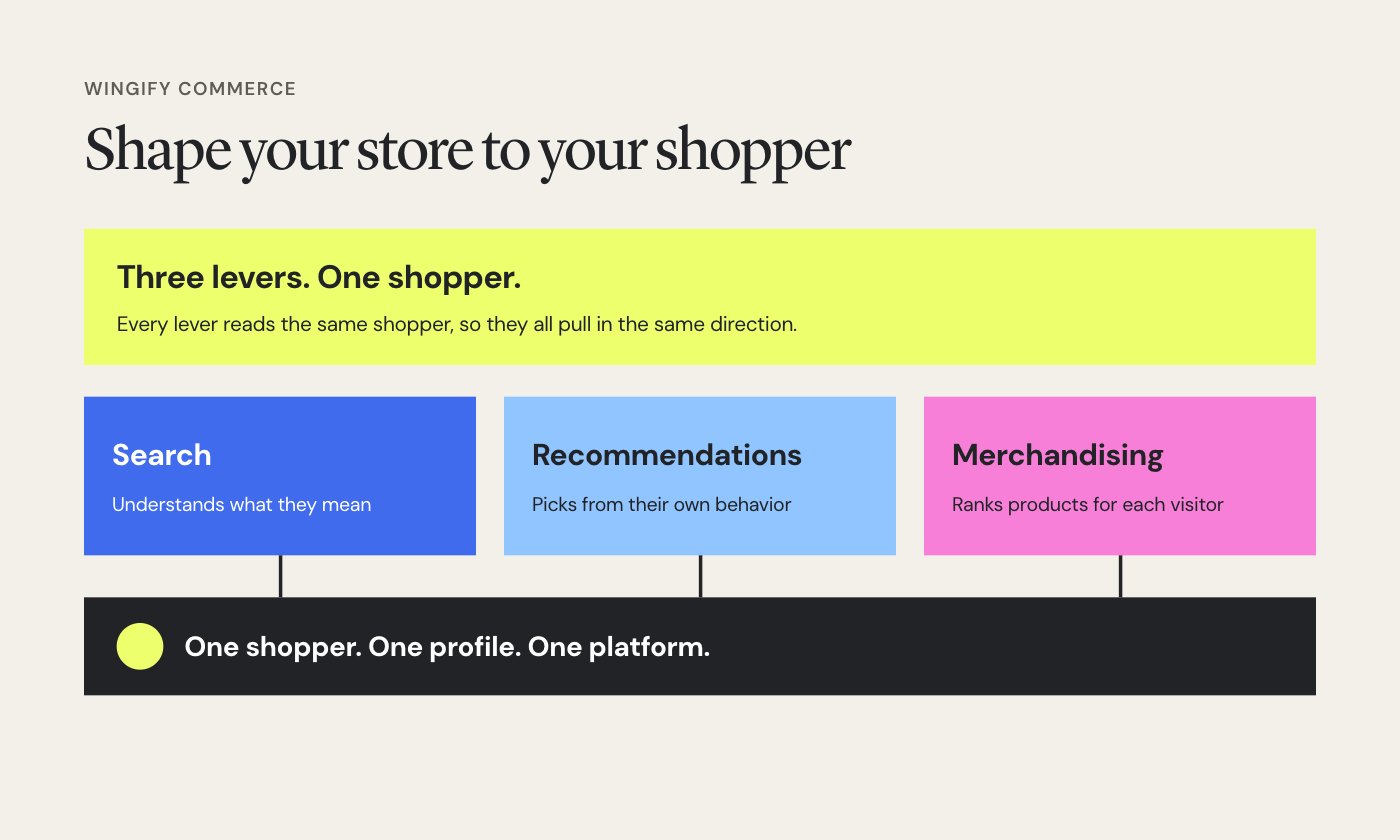
Wingify Commerce brings search, recommendations, and merchandising onto one platform, so every part of the store responds to the same context and signals.
Here’s what that looks like at each critical decision moment:
1. When they search: meet intent in their own words
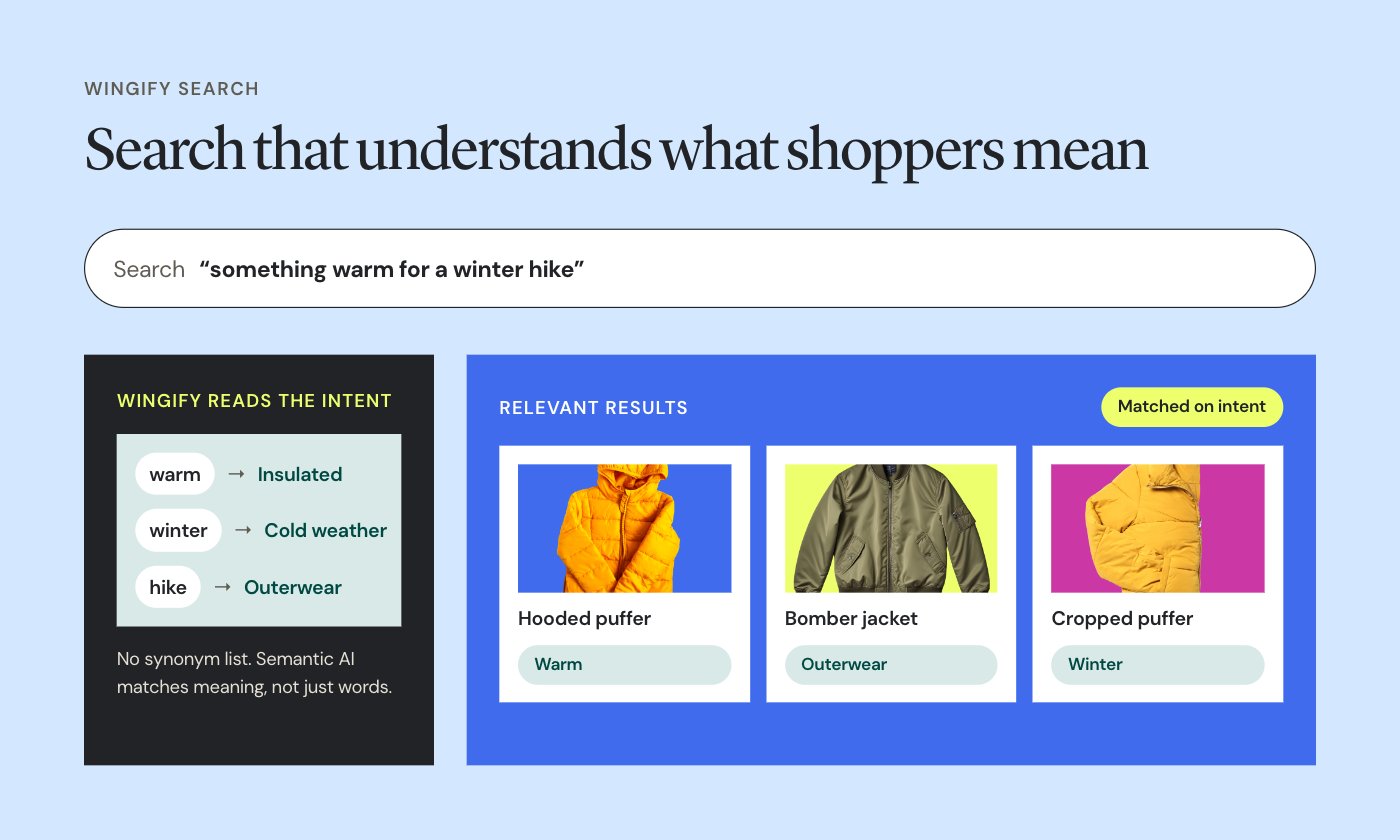
Search is where shoppers tell you exactly what they want. But the problem is they rarely use your catalog’s terms and language. They just describe the item in their own words instead of naming a product, while searches on mobile come with loads of typos.
A keyword-based search bar struggles with these queries, returning irrelevant products or an empty page, so a shopper with clear intent leaves before seeing what you sell.
Wingify Search is built to close that gap. Being semantic-first, it interprets the meaning behind a query, so even terms that seem vague, conversational, or misspelled can still lead shoppers to relevant products.
It also gives your team control over what appears at the top, so you can boost seasonal products, bury low-priority ones, and apply campaign promotions directly to search results, without raising an engineering ticket.
2. When they browse: move the shelf with the season
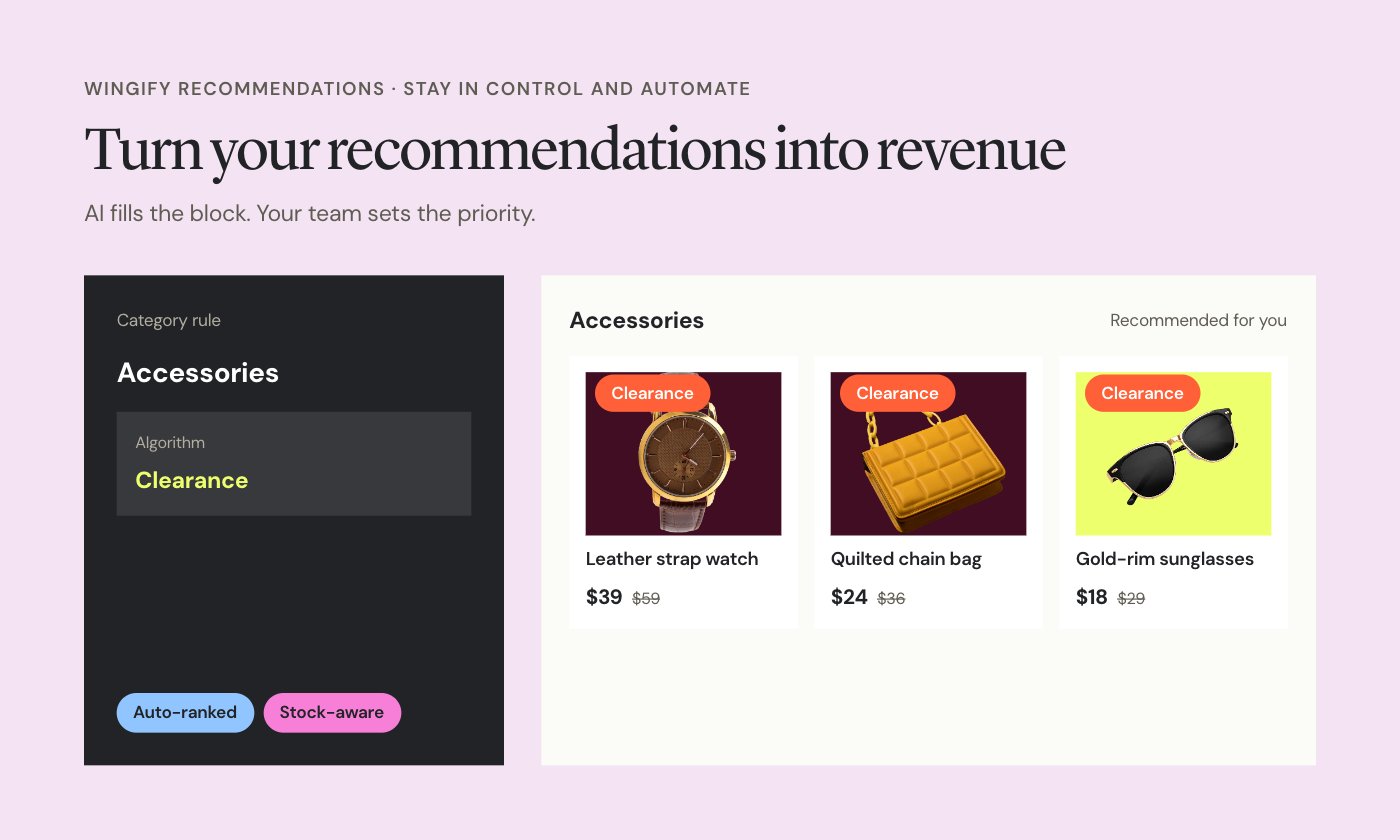
Category pages are where most shoppers start narrowing down their options, yet many still show the same fixed order to everyone.
A ranking set up in October rarely reflects what a Black Friday deal hunter or a last-minute buyer is looking for. Changing it usually means waiting on developers, leaving shoppers with a ranking order that doesn’t align with their needs.
Wingify Recommendations puts that control back in your team’s hands so that they can reshape a category page the same day the season shifts.
In practice, that means your team can move gift-ready items up ahead of the last shipping date, push overstock during a sale, or run a Black Friday ranking on one category without changing the page for shoppers outside the campaign.
Your team can also test ranking strategies against each other, comparing manual rules, AI-driven ranking, or a mix of both, to see which order drives the most revenue.
And because a rule carries across search and recommendations too, one decision shapes the whole store.
3. When they compare: keep the choice on your site
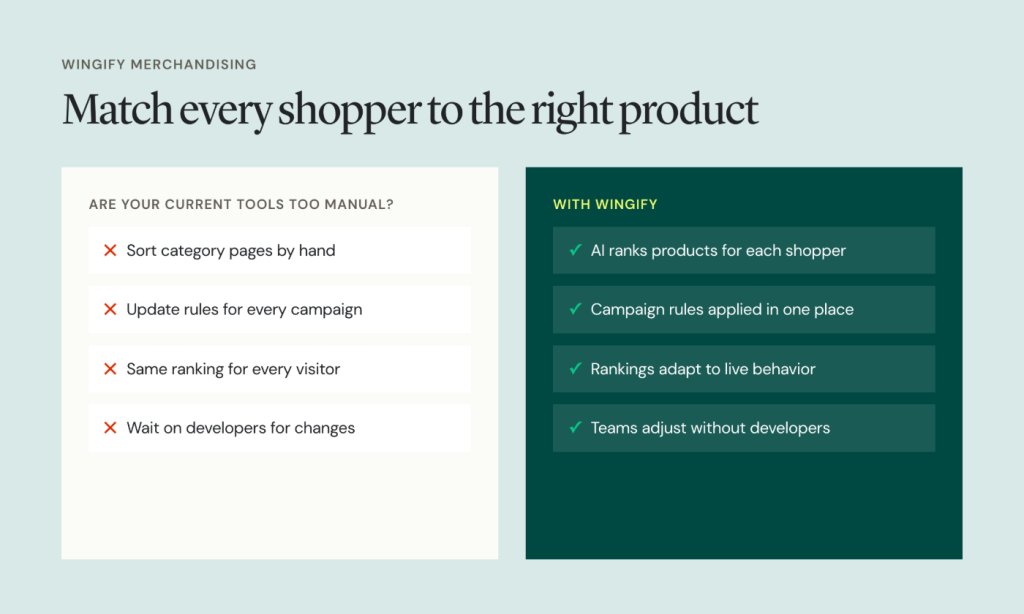
On a product page, a shopper is deciding whether an item is the right choice or whether something else would suit them better.
If the recommendations show the same bestsellers everyone sees, or the product is out of stock with nothing similar offered, shoppers are forced to look elsewhere.
Wingify Merchandising helps your team keep that comparison going on your own site. When a product doesn’t quite fit, or has sold out, you can recommend similar products and alternatives to give the shopper another option to consider.
When they’ve found the right item, frequently bought together picks drawn from real purchase combinations can help buyers make relevant, useful purchases.
For first-time visitors, recommendations draw on what they’re browsing currently, so suggestions reflect this visit rather than an empty purchase history.
Your team chooses which recommendations appear on each page, previews them before they go live, and can test one approach against another to see which drives more revenue.
4. When they want to buy: add value, not just discounts
By the time shoppers reach the cart, the decision is close, and a discount can seem like the quickest way to secure it.
However, a blanket discount often impacts your margin on orders that might have happened anyway. Also, pressure tactics like low-stock warnings can erode the trust a shopper has built with your brand.
With Wingify Commerce, your team can use the cart itself to offer value to the order. Recommendations for relevant add-ons and complementary items give shoppers useful ways to complete their purchase.
Discounts stay in your hands too, as you decide how often an offer appears and to whom, so it’s shown only to shoppers who need it.
Brands that got it right at peak decision moments
La Fée Maraboutée used Wingify to drive 11.7% more revenue per user
La Fée Maraboutée is a French women’s ready-to-wear brand known for creative, timeless collections. Its search bar looked right but worked against shoppers.
The native Shopify search lacked typo tolerance and semantic understanding, so even minor spelling errors or variations in wording led to poor results or “no products found” pages.
To fix this without disrupting the familiar experience, the team ran a campaign with Wingify Search that kept the original search preview design while adding typo handling and semantic search to the results.
Within the first two weeks, revenue per user rose by 11.7% and the add-to-cart rate by 9.4%.
Groupe Équipement de la Maison lifted homepage conversions by 21% with Wingify
Groupe Équipement de la Maison, the parent company of Bricomarché, Brico Cash, and Bricorama, runs more than 800 stores and sells a catalog of over 250,000 products.
However, manual recommendations were slowing the team down and proving to be unsustainable. Using Wingify Recommendations and Merchandising, the team decided to bring personalized recommendations to each step of the journey.
- On the homepage, they tested best sellers and frequently viewed items against a version with no recommendations at all.
- Product pages showed curated picks that left out items the visitor had already viewed.
- Cart pages suggested products frequently bought together.
- When a search returned no results or a visitor landed on a 404 page, the site showed the past two weeks’ top sellers to keep them browsing.
Through this campaign, homepage conversions rose by 21% and average basket value on product pages grew by 21%. This enabled the team to streamline recommendations and also freed up time for higher-value projects.
Grab the smaller moments to win the bigger season
When each moment in search, category pages, product pages, and the cart answers what a shopper came for, more visits end in orders.
The payoff also lasts beyond the season, as first-time buyers who found exactly what they needed in December have a reason to come back after the holidays.
Wingify Commerce is built to help your team manage those moments from one place. With search, recommendations, and merchandising working from the same understanding of each shopper, you can deliver experiences that feel more relevant as the visitor’s journey unfolds.
Get in touch with Wingify Commerce to take a closer look at the moments that make or break your holiday season.

Hi, there! I’m an Associate Manager of Content at VWO with 6 years of experience in B2B and B2C marketing. I work across blogs, SEO, thought leadership, newsletters, landing pages, and a video podcast I built and manage from scratch. At VWO, I’ve gained expertise in CRO, experimentation, user behavior research, and personalization, creating content that makes complex ideas clear and actionable. Outside of work, I enjoy experimenting with memes and short-form video on Instagram.